


Explore Kirifuri Highlands from Kisuge-daira Park
Kirifuri Highlands (Kirifuri Kōgen), a highland area on the slopes of Mount Akanagi in Nikkō, Tochigi Prefecture, is known for its 1,445-step Tenkū-kairō (Sky Corridor) staircase and fields of Nikkō-kisuge daylilies.
Add time in nature to your Nikkō trip by walking among the flowers or climbing the Sky Corridor for views of the mountains.
What Is the Difference Between Kirifuri Highlands and Kisuge-daira Park?
Kirifuri Highlands is the name of the area, and one of its main walking destinations is Nikkō Kirifuri Highlands Kisuge-daira Park.
Kisuge-daira Park opened in April 2013 and extends across the middle slopes of Mount Akanagi at elevations of 1,300–1,600 m.
If you are visiting for the fields of Nikkō-kisuge daylilies or the staircase called the Sky Corridor, using this park as your destination will make planning easier.
When searching maps, use the park's full name as well as the area name, and check exactly where you will arrive.
Saving the address, 1531 Tokorono, Nikkō, Tochigi Prefecture, will also make it easier to set your destination in a car navigation system or map app.
A Park Preserving the Grassland on Former Ski Slopes
Kisuge-daira is also known as the site of former ski slopes and lifts, and is now maintained as a nature park with the Sky Corridor, walking trails, and a rest house.
After deer grazing caused a sharp decline in Nikkō-kisuge daylilies, deer-exclusion fences were installed, and the grassland is maintained through fall mowing and supplementary planting.
These efforts led to its inclusion in the first selection for the “100 Grassland Communities to Preserve for the Future” in 2022, which recognized 34 locations across Japan.
The park is managed and operated by the Natural Parks Foundation, the designated manager appointed by Nikkō City.
Kirifuri Highlands Rest House Opening Hours and Facilities
The park's rest house has seating areas, an information corner, restrooms, and food and drink facilities.
Typical opening hours are 9:00 a.m.–5:00 p.m. from April to November and 9:00 a.m.–4:00 p.m. from December to March, with closure over the New Year holiday period from December 29 to January 3.
The park itself is accessible 24 hours a day, but if you plan to rest or eat at the rest house, arrange to arrive during its opening hours.
Inside are ramps, an elevator, and an accessible multipurpose restroom, and wheelchairs are also available to borrow.
The food and drink facilities serve items such as curry and coffee, making them an option for a break before or after your walk.
Before setting off, check the map to identify your location, how far you plan to walk, and your route back.
Opening hours and closing days may change, so check the facility's information before your visit if you plan to use it.


How to Walk the Sky Corridor's 1,445 Steps and the Park Trails
At Kisuge-daira Park, you can climb the stairs for the views or explore flowers and other plants along the walking trails.
Keep enough energy for the return journey rather than focusing too much on reaching the top: this is the key to a comfortable walk.
The Sky Corridor: 1,445 Steps to Komaruyama Observation Deck
The Sky Corridor is a staircase of 1,445 steps running from the front of the rest house to Komaruyama Observation Deck at the upper end of the park.
There is an elevation gain of about 240 m from the bottom to the top, so take it at your own pace and pause along the way to catch your breath.
The staircase stretching up the slope is itself a distinctive part of the landscape, and looking back over the route you have climbed reveals the highlands from a different angle.
Views from the observation deck depend on the weather, so avoid packing your itinerary on the assumption that distant scenery will be visible.
Panoramic Views of the Kantō Plain from Komaruyama Observation Deck
Komaruyama Observation Deck overlooks the Kantō Plain, and on clear days you may even see the Pacific Ocean and Tokyo Skytree.
Mountain weather changes quickly, and fog or clouds may obscure the view, so check the forecast before you begin your climb.
After enjoying the scenery, leave plenty of time and energy for your return, remembering that descending the stairs can put strain on your knees.
Include the Walking Trails to Enjoy the Flowers
The park also has maintained walking trails that let you reach the middle slopes without using the stairs.
If you want to take a closer look at the plants, check how the trails connect on the map and choose a route where you can stop at places that interest you.
Even routes without steps have slopes, so do not expect the same conditions as a flat park.
Benches are provided along the trails, so take regular breaks as you walk.
Birds such as meadow buntings, Japanese bush warblers, and blue-and-white flycatchers can also be seen in early summer, and binoculars can add another dimension to your walk.
Choose a Turnaround Point When Visiting with Children or Using a Wheelchair
If you are with children or are unaccustomed to stairs, you can plan to turn back partway depending on how tired everyone feels once you start walking.
The park has a wheelchair-accessible trail reached from the rest house.
If you use a wheelchair, checking in advance with the facility which accessible routes around the rest house are available will help you plan.
If you intend to follow mountain or hiking routes beyond the park, prepare a separate map, equipment, and itinerary for that outing.


When to See Nikkō-kisuge Daylilies and What to Enjoy in Each Season
The colors of the flowers and foliage in Kirifuri Highlands change with the seasons.
If there is a particular plant you want to see, check local blooming updates before your visit rather than relying on the calendar alone.
The Natural Parks Foundation, which manages the park, also shares local conditions on X, formerly Twitter, and through live YouTube streams.
Nikkō-kisuge Daylilies Usually Bloom from Mid-June to Mid-July
Kisuge-daira Park is known for its fields of Nikkō-kisuge daylilies, which can usually be enjoyed from mid-June to mid-July.
The slopes are said to have around 260,000 Nikkō-kisuge plants, and yellow flowers spread across the landscape at peak bloom.
Nikkō-kisuge is another name for the flower zenteika; although it grows throughout Japan, it is cherished as a symbol of Nikkō, as its name suggests.
However, the progress of flowering and the peak viewing period depend on the weather and other conditions, so the scenery will not be the same throughout the season.
Comparing the shapes of nearby flowers with the sweep of color across the whole slope can give you different impressions even along the same trail.
Spring Dogtooth Violets and Azaleas, Fall Foliage, and Winter Snow
Flowers such as katakuri, or Japanese dogtooth violets, and wild azaleas in spring, colorful trees and grasses in fall, and snowy scenery in winter each give the highlands a different character.
Witch hazel usually begins blooming around late March, followed by dogtooth violets and azaleas from April to June, while gentians may also be seen in fall.
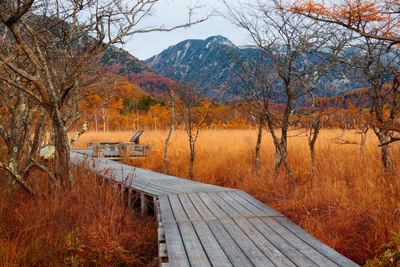
Fall foliage is usually at its best from early to late October, although the timing varies from year to year.
Even outside the flowering season, looking at the colors of the trees and the contours of the slopes lets you appreciate each season's scenery.
In winter, visitors can enjoy snow play and snowshoeing, but preparation for snow and ice is essential; avoid walking in the same clothes and shoes you would wear in snow-free seasons.
The Sky Corridor steps can become icy and slippery in winter, so do not push yourself to climb higher.
The table below outlines seasonal scenery and points to check when planning.
| Season | Scenery to enjoy | What to check when planning |
|---|---|---|
| Spring | Flowers such as dogtooth violets and azaleas | Blooming conditions and footing |
| Early summer to the summer flowering season | Nikkō-kisuge daylilies (usually mid-June–mid-July) | Blooming conditions and rain preparation |
| Fall | Colorful trees and autumn grasses | Foliage conditions and cold temperatures |
| Winter | Snow-covered slopes and snowshoeing | Snow, ice, and suspended bus services |


How to Get to Kirifuri Highlands: Buses, Driving, and Your Return Journey
If you are using public transportation, checking the return buses as well as outbound services beforehand makes it easier to decide how far to walk.
If you are driving, check seasonal road conditions and parking information as well.
About 30 Minutes by Bus from JR Nikkō or Tōbu-Nikkō Station
To reach Kisuge-daira Park, take a bus bound for Kirifuri Kōgen from JR Nikkō Station or Tōbu-Nikkō Station and get off at Kirifuri Kōgen bus stop.
The bus ride takes about 30 minutes, and Kisuge-daira Park is a short walk from Kirifuri Kōgen bus stop.
Tōbu Bus services to Kirifuri Kōgen run seasonally from April 1 to November 30 and are suspended from December to March, so check the operating route and timetable for your visit date.
During the operating season, 5 buses a day depart from Tōbu-Nikkō Station for Kirifuri Kōgen, with the last departure between 3:00 p.m. and 4:00 p.m.
Services are limited, so check your return bus time first and consider how you would travel if you missed it.
Before boarding, check the destination display to make sure the service goes to your destination.
Distinguish Kirifuri no Taki Bus Stop from Kirifuri Kōgen Bus Stop
The Tōbu Bus stops Kirifuri no Taki and Kirifuri Kōgen are different stops; for the Sky Corridor, get off at Kirifuri Kōgen.
Buses bound for Kirifuri Kōgen pass through Kirifuri no Taki on the way, so take care not to get off too early.
In winter, from December 1 to March 31, buses run to Kirifuri no Taki via Nikkō Kirifuri Skate Center, but do not continue to Kirifuri Kōgen.
Saving the Japanese bus stop names on your smartphone makes it easier to confirm the destination when boarding.
If you also want to visit the waterfall, plan your onward journey after getting off the bus and your return services as well.
About 25 Minutes by Car from Nikkō Interchange
By car, Kisuge-daira Park is about 25 minutes from Nikkō Interchange on the Nikkō-Utsunomiya Road.
In winter, snow and icy roads are possible, so prepare tire chains or studless winter tires.
Visitors parking for a long period, such as for a mountain hike, are asked to use Parking Lot 3.
Check Kisuge-daira Park Parking Fees and Allow Time for Your Return
Parking at Kisuge-daira Park is paid, with fees varying by season and vehicle type.
For passenger cars, parking costs 500 yen in April, May, and September, and 1,000 yen in June, July, August, October, and November; motorcycle parking costs 500 yen from April to November.
Visits of up to 30 minutes and parking in winter, from December to March, are free.
Do not rely solely on older information describing parking as free; check the current Nikkō City guidance.
Whether you travel by bus or car, allowing time for the descent, breaks, and the walk back to your boarding point will let you enjoy the scenery at a relaxed pace.


What to Wear and Bring for Hiking in Kirifuri Highlands
For a day on stairs and slopes, add protection against cold and rain to your usual sightseeing clothes.
The highlands, at elevations above 1,300 m, tend to be cooler than central Nikkō, so bring a light jacket even in summer.
A bag that leaves both hands free will make walking easier and save you from having to rearrange your belongings along the way.
Bring Comfortable Shoes and Layers
Choose familiar shoes with good grip and carry a jacket you can put on or remove to suit the temperature and wind.
Watch your footing on wet stairs, and always stop before taking a photo.
Keep drinks and rain gear handy so you are ready for breaks and changes in the weather.
The sun can be strong at Kisuge-daira Park on clear days, so bring a hat and sunscreen, drink water regularly, and take precautions against heat illness.
- Familiar shoes with good grip
- A removable outer layer and rain gear
- A hat and sunscreen
- Drinks and snacks that are easy to eat while out walking
- A charged smartphone and a trail map
Watch for Land Leeches on Nearby Trails from June to October
Take precautions against land leeches on routes around Kirifuri Highlands, including Ōyama, Maruyama, the Old Trail (Boshin no Michi), and the Hidden Three Waterfalls (Kakure Santaki).
Sightings and bites are reported particularly often during rain and the following day from June to October, so wear long sleeves, long pants, and thick socks, and keep checking around your feet as you walk.
If you extend your walk from the park onto nearby trails, check local advisories as well as the weather before setting off.
If you walk the surrounding mountain trails, carrying something that makes noise, such as a bear bell, can help you prepare for encounters with wildlife.

Photography and Walking Etiquette to Protect Nature
When photographing flowers or the stairs, respect the plants and leave space for others to pass.
Check your footing and the movement of people around you before framing your shot.
Keep the Sky Corridor Clear While Photographing the Highlands
Including the line of the staircase can convey the depth of the slope, while framing flowers with the surrounding greenery captures the season's atmosphere.
Choose your position before taking a photo, rather than stepping backward while looking at the screen or spreading bags across the path.
If other travelers' faces will appear prominently in your shot, be considerate and speak to them first.
Tips for an Early-Morning Visit to See the Kirifuri Sunrise
Photos of the Kirifuri sunrise have spread on social media in recent years, bringing more visitors to Kisuge-daira Park specifically for dawn.
The stairs and trails are hard to see before daybreak, so bring a light and avoid moving unnecessarily until it becomes brighter.
Early in the morning, the rest house has not opened and buses are not running, so bring your own warm clothing and drinks.
Litter and discarded cigarette butts are an issue in the park, so take all your trash with you and never leave cigarette butts behind.
Keep Your Distance from Plants and Follow Local Instructions
To avoid damaging vegetation, stay on maintained paths when viewing or photographing flowers.
Follow any signs restricting entry or passage, and do not pick flowers or step into vegetation to take a shortcut.
The park has fences to keep deer out, so follow local instructions, including closing any entrance gates after passing through them.
The following table outlines ways to respect nature and those around you while walking.
| Situation | What to do | What to avoid |
|---|---|---|
| Viewing flowers | Observe from the path | Picking flowers |
| Taking photos | Leave the path clear | Blocking the stairs |
| Taking a break | Keep your belongings together | Spreading them across the path |
| After eating or drinking | Take your trash with you | Leaving food scraps behind |
Walk the Kirifuri Highlands Sky Corridor at Your Own Pace
At Kisuge-daira Park in Kirifuri Highlands, you can enjoy both the views from the Sky Corridor and the flowers along the walking trails.
Choose a season to suit the scenery you want to see, check bus operating dates, parking fees, and the weather, and walk only as far as your fitness comfortably allows.
Rather than focusing only on reaching the top, notice the flowers at your feet and the views along the way for a highland walk that suits you.




Reviews (0)