


Koinoki Shrine: Essential Shrine Etiquette Before Your Visit
If you plan to visit Koinoki Shrine within the grounds of Mizuta Tenmangū Shrine in Chikugo, Fukuoka Prefecture, knowing the basics of Japanese shrine etiquette will help you feel at ease when you arrive.
A shrine is a place to express wishes and gratitude to the deities, so respect the feelings of people praying as you spend time on the grounds.
Koinoki Shrine is cherished for its deity of matchmaking, and it is worth remembering that people around you may have come with deeply personal wishes.
Think About Your Wishes for Relationships in Your Own Words
Before praying, think about what matters to you now and anyone you would like to thank.
Koinoki Shrine accepts prayers for romantic fulfillment and good relationships, as well as marriage and marital harmony.
The shrine also explains that en, meaning connections, extends beyond romance to encounters throughout life, such as friendships, work, and the blessing of children.
Putting your wishes into a few simple words beforehand allows you to focus quietly before the deity without struggling to find what to say.
Rather than worrying too much about finding a set phrase in Japanese, gather your thoughts silently in your own words.
Understand the Difference Between Personal Prayer and a Priest-Led Prayer Ceremony
At Japanese shrines, the procedures differ between offering your own prayer in front of the shrine building and requesting a kitō prayer ceremony in which a priest conveys your wishes to the deity.
You can pray on your own freely within the grounds, and there is no fixed amount for a monetary offering.
For a kitō prayer ceremony, you apply at the reception counter and make a ritual offering known as hatsuhoryō, after which a priest conveys your wishes to the deity.
Koinoki Shrine lists reception for its regular prayers for good relationships as 9:00 a.m.–4:00 p.m., with a hatsuhoryō offering of 5,000 yen.
Reservations are requested for weekday prayer ceremonies, so contact the Mizuta Tenmangū shrine office in advance at 0942-53-8625 to ask about reception hours and arrangements for your visit.
For a first visit, deciding whether you want to pray on your own or also request a priest-led ceremony will make your preparations clearer.
Here are the main differences between personal prayer and a priest-led ceremony at Koinoki Shrine.
| Item | Personal Prayer | Regular Prayer Ceremony for Good Relationships |
|---|---|---|
| What it involves | Offer your own prayer and express your wishes | A priest conveys your wishes to the deity |
| Offering | Monetary offering of any amount | Hatsuhoryō offering of 5,000 yen |
| Application | Not required | Reception from 9:00 a.m.–4:00 p.m. |
| Reservation | Not required | Reservations requested on weekdays |
| Items you may receive | Request items at the shrine counter if you wish | Ofuda talismans, omamori amulets, and other items |


What Is Koinoki Shrine? Its Deity and Highlights Within Mizuta Tenmangū
Koinoki Shrine, or Koinoki-jinja, is a subsidiary shrine within Mizuta Tenmangū at 62-1 Mizuta, Chikugo, Fukuoka Prefecture.
Its enshrined deity is Koi no Mikoto, regarded as a deity of love, and Koinoki Shrine is said to be the only shrine in Japan dedicated to this deity.
According to tradition, the deity was enshrined to console Sugawara no Michizane, who ended his life in Dazaifu while longing for the emperor and for his own family back in the capital.
The main shrine, Mizuta Tenmangū, was established in 1226, the 2nd year of the Karoku era, by Sugawara no Tamenaga under the imperial command of Emperor Go-Horikawa, and enshrines Sugawara no Michizane, known as the deity of learning.
Its main sanctuary was rebuilt in 1672, the 12th year of the Kanbun era, and was designated a cultural property of Fukuoka Prefecture in 1961, the 36th year of the Shōwa era.
Mizuta Tenmangū is considered one of Kyushu's 2 great Tenmangū shrines, ranking after Dazaifu Tenmangū.
The Heart-Tiled Koi Sandō Path and Koinoki Torii Gate
The Koi Sandō approach leading to Koinoki Shrine's main sanctuary is paved with heart-shaped ceramic tiles.
These are Mizuta-yaki ceramics fired at Mizuta Tenmangū's kiln, and they are said to take around 1 month to make because firing them requires advanced skill.
The Koinoki Torii gate features 10 heart motifs expressing wishes for good relationships and happy encounters.
There are also 2 heart-shaped Koinoki stone lanterns on the grounds, said to be lit on New Year's Eve and during festivals.
Look for the Sacred Couple Figures and Trees
In front of Koinoki Shrine's main sanctuary stand the sacred Koi-musubi Meoto-bina couple figures, which are believed to bring blessings when stroked.
Women are said to receive blessings by stroking the male figure, men by stroking the female figure, and couples visiting together by stroking both figures.
The grounds also contain the Goen Kusu camphor tree, said to have formed when 2 trees joined into 1, and the Kōfuku no Ichii no Ki, or tree of happiness, believed to be 600 years old.
Walking around the tree of happiness to the left, then right, then left again is said to bring happiness.

How to Pray at Koinoki Shrine: From the Torii Gate to the Sanctuary
Shrine etiquette expresses respect for the deities through your actions.
Follow any local instructions on etiquette and movement first, and move at a comfortable pace with those around you.
Be Considerate of Others at the Torii Gate and Along the Approach
A slight bow when passing through the torii gate is a polite way to greet the shrine.
Because Koinoki Shrine is a subsidiary shrine within Mizuta Tenmangū, it is more courteous to pray at the main Mizuta Tenmangū shrine before continuing to Koinoki Shrine.
There is also a custom of avoiding the center of the approach, but do not focus so much on form that you block someone else's way.
Step to the side of the path when looking at maps or signs, and check the flow of people before stopping to talk with your companions.
Use the Purification Facilities According to the Instructions
Temizu is the practice of cleansing your hands and mouth before prayer to prepare yourself mentally.
If purification facilities are available, follow the posted instructions and avoid splashing water widely around you.
With the usual ladle method, first scoop up water and rinse your left hand, then your right.
Next, pour water into your left palm to rinse your mouth, then rinse your left hand again.
Do not put your mouth directly on the ladle, and do not return the water from rinsing your mouth to the basin.
Finally, hold the ladle upright so the remaining water runs down the handle, then return it to its place.
Wait Your Turn, Then Offer 2 Bows, 2 Claps, and 1 Bow
If people are lined up to pray, wait until the person ahead has finished before approaching.
The usual procedure is to make a monetary offering, bow deeply 2 times, clap 2 times at chest height, join your hands in prayer, and finish with another deep bow: 2 bows, 2 claps, and 1 bow.
The same basic pattern of 2 bows, 2 claps, and 1 bow applies when enshrining and praying before an ofuda talisman you have received.
Check local signs for how to bow and clap, and take your time when offering your prayer.
After praying, make room for the next person, and organize your belongings or check photos somewhere that does not obstruct others.


Koinoki Shrine Amulets, Ema Plaques, and Love Fortunes: What They Mean
Japanese shrines have a tradition of entrusting wishes to omamori amulets, ema wooden prayer plaques, and similar items.
At Koinoki Shrine, heart-shaped designs appear in the shrine crest, amulets, fortune slips, and ema plaques.
The stated hours for receiving amulets and goshuin commemorative shrine seals are 9:00 a.m.–5:00 p.m.
Available items and their hatsuhoryō offerings may change with the season, so check the information on the day if there is something you would like.
Learn the Meaning Behind the Heart-Shaped Amulets
Omamori are treasured as items kept close to you in the hope of receiving divine protection.
When choosing one at the shrine counter, read the description to understand the wish it represents, rather than looking only at its color or shape.
Koinoki Shrine's ceramic Heart Mamori amulet requires an offering of around 1,000 yen and is said to be available only at the counter on the grounds, rather than by mail.
Other amulets include the Aisare Mamori, for being loved, and the Ryōen Kōfuku Shīru Mamori, a sticker amulet for good relationships and happiness, each with an offering of around 1,000 yen.
At the Ryōen Jōju-sai festival for good relationships on November 3, the Yukari no Ito Mamori amulet, woven from threads of an ōnusa purification implement, is offered for 1,000 yen and is listed as available for 1 week from that day.
If receiving an amulet for someone special, sharing the thoughts behind it when you give it to them can also share part of your shrine experience in Japan.
Read the Words on Love Fortunes and Ema Plaques
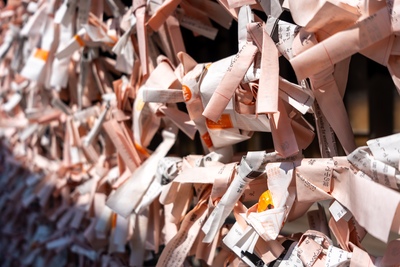
Ema are plaques on which you write wishes or thanks before offering them to the shrine.
The offering for an ema is around 500 yen, and donated plaques are said to be purified and then ritually burned at the end of the year.
When writing on an ema, remember that other visitors may see it and avoid including too much personal information, such as your address or contact details.
Koinoki Shrine's koi-mikuji love fortune slips change to pink paper in February, March, October, and November.
Rather than focusing only on whether a fortune is good or bad, you can also enjoy reading its words as a prompt to consider your future actions.
If you want to tie up your fortune slip as an offering, check the designated place and do not attach it to tree branches or buildings without permission.
Here are the general meanings of terms you may see at the shrine counter.
| Term | General Meaning | What to Notice |
|---|---|---|
| Omamori | A prayer item kept close to you | The wish it represents |
| Ema | A votive plaque for recording your thoughts | Where to offer it |
| Omikuji | A fortune or guidance for daily life | The advice written on it |
| Hatsuhoryō | An offering to the deity | What it is for and how to make it |


What to Check When Requesting a Goshuin at Koinoki Shrine
A goshuin is a seal received as a record of visiting a shrine or temple to pray.
Koinoki Shrine has 2 goshuin designs: one showing a torii gate and the sacred couple figures inside a heart, and another showing a torii gate and the shrine building inside a heart, with an offering of around 500 yen each.
Designs and offerings can change, so check availability and the procedure before building them into your plans.
Check Goshuin Counter Hours Separately From Your Prayer Visit
Treat access to the shrine grounds for prayer and the availability of the goshuin counter as separate things to check to avoid misunderstandings.
Goshuin are available during the counter's opening hours of 9:00 a.m.–5:00 p.m., so check those hours in advance if you expect to arrive toward evening.
If you would like the seal written directly in your goshuin-chō seal book, ask first whether that option is available.
Even if you have seen a goshuin in older travel photos, the same design or method of receiving it may no longer be offered.
Explain Your Request Briefly at the Counter
Tell the staff what you would like, then listen to the instructions on when to hand over your seal book and how to collect it.
If communicating in Japanese is difficult, showing a screen with Japanese text meaning that you would like a goshuin can make your request easier to understand.
Wait somewhere that does not disturb others praying, then store the goshuin carefully so it does not become bent or wet while you travel.

Photography and Walking Etiquette at Koinoki Shrine
When taking photographs at the shrine, first check where photography is allowed and how to respect worshipers.
The heart-tiled Koi Sandō approach and Koinoki Torii gate are tempting photo spots, but they are also routes used by people coming to pray.
Separating photography from quiet prayer time helps both you and those around you enjoy a calmer visit.
Read Photography Signs and Check Restricted Areas
Do not take photos where photography is prohibited, and ask a priest or counter staff before photographing inside shrine buildings or during ceremonies.
Where access is restricted, do not cross fences or boundaries, even to look for a better composition.
Handle Photos of People and Their Wishes With Care
Even when photographing a companion, choose a position that avoids prominently capturing people praying behind them or the writing on someone else's ema.
Before publishing your photos, check whether names or faces are identifiable.
Keep Photography Equipment and Bags Out of the Way
If you want to use a tripod or similar equipment, check whether it is allowed and where you may set it up.
Avoid stepping backward while looking only at your phone screen; check your footing and what is behind you before changing position.
Here are considerate actions and things to avoid in situations that can cause uncertainty during a shrine visit.
| Situation | Considerate Action | What to Avoid |
|---|---|---|
| Talking on the grounds | Match your voice level to the surroundings | Calling out loudly |
| Walking around the shrine | Watch your footing and surroundings | Moving while looking at a screen |
| Viewing architectural details | Observe from a distance | Moving decorations |
| Handling belongings | Keep them together close to you | Blocking paths with bags |

Koinoki Shrine Festivals and Tips for Avoiding Crowds
Koinoki Shrine holds several festivals each year connected with good relationships and romantic bonds.
Here are the main festivals and times when visitor numbers tend to increase.
| Festival or Period | Date | What Happens |
|---|---|---|
| Ryōen Jōju-sai | March 3 and November 3 | Special prayers for good relationships |
| Koi-musubi Matsuri | July 7 (2:00 p.m.) | Purification and prayers before the sacred couple figures |
| Ennichi shrine observance days | The 1st, 5th, 15th, and 25th of every month | Shrine observances held on fixed dates each month |
| Before Valentine's Day | Late January–February 14 | Many visitors come to entrust their wishes to the deity |
The November 3 Ryōen Jōju-sai begins at 11:00 a.m., and reception for special prayers that day runs from 10:30 a.m.–4:30 p.m.; to receive a special prayer during the 11:00 a.m. ceremony, apply by 10:45 a.m.
At the Ryōen Jōju-sai, limited quantities of Koinoki manjū sweet buns and ameyu, a ginger drink, are served free of charge.
Many people begin visiting in late January ahead of Valentine's Day on February 14.
For a quieter visit, avoid festival days and weekends around Valentine's Day, and aim for close to 9:00 a.m., when the shrine counter opens.
If you want to experience a festival, arriving before the start leaves more time for reception and moving around.
How to Get to Koinoki Shrine and Plan Your Visit
Planning becomes easier when you consider the return trip and the day's weather as well as how to get there.
Check Routes From the Nearest Stations and Plan Your Return
Before leaving, find Mizuta Tenmangū and Koinoki Shrine on a map at 62-1 Mizuta, Chikugo, Fukuoka Prefecture, and save the route from your accommodation.
If traveling by train, the nearest station is Hainuzuka Station on the JR Kagoshima Main Line, about 5 minutes away by car or 20–25 minutes on foot.
From Chikugo-Funagoya Station, served by the Kyushu Shinkansen and JR Kagoshima Main Line, it is around 8 minutes by car.
If taking a local bus, the nearest stop is Nishitetsu Bus's Mizuta-Tenmangū-Koinoki-Jinja-mae bus stop.
By car, it is around 10 minutes from Yame IC on the Kyushu Expressway, and parking is available for shrine visitors.
If using public transportation, check your return station or bus stop and service schedule so you can enjoy the grounds without constantly watching the time.
Allow time for transport delays and possible waits at the counter, and avoid filling your schedule too tightly after the visit.
How Long to Allow and When the Shrine Counter Opens
Allow around 30 minutes to 1 hour to pray at Mizuta Tenmangū and Koinoki Shrine, see the Koi Sandō approach and Koinoki Torii gate, and stop at the shrine counter at a relaxed pace.
Amulets and goshuin are available from 9:00 a.m.–5:00 p.m., while reception for regular prayer ceremonies runs from 9:00 a.m.–4:00 p.m., so avoid arriving late in the afternoon if you would like either.
If requesting a prayer ceremony, allow extra time for reception and waiting.
Wear Comfortable Clothing and Prepare to Communicate
Choose comfortable walking shoes and dress for the temperature and rain in a way that leaves both hands easy to use.
Keeping essentials in a small bag makes it easier to pray and receive items at the shrine counter.
Use a translation app or similar tool before departure to check anything you are unsure about, such as prayer ceremony reception hours and the hatsuhoryō offering.
If you are not comfortable with Japanese, preparing short sentences for questions you want to ask on arrival can help.
- May I take photos here?
- What kind of wish is this amulet for?
- I would like to ask about reception; where should I inquire?
Planning Your Koinoki Shrine Visit
Koinoki Shrine, dedicated to Koi no Mikoto within the grounds of Mizuta Tenmangū, is an unusual matchmaking shrine in Japan.
Before visiting, learn the basics of Japanese shrine etiquette and consider what you wish to pray for and how you would like to spend your time.
Check counter hours if you would like amulets or a goshuin, and confirm reception hours and reservation requirements for a priest-led ceremony; when taking photos, follow local instructions and respect other visitors.
Even if the language and customs are unfamiliar, observing those around you and acting calmly will help you spend time in a way that suits this place of prayer.



Reviews (0)