


Oku-Nikkō Yumoto Onsen: Sulfur Hot Springs on the North Shore of Lake Yunoko
Oku-Nikkō Yumoto Onsen is a hot spring resort with milky-white sulfur waters on the shores of Lake Yunoko, at an elevation of about 1,500 m within Nikkō National Park in Nikkō, Tochigi Prefecture.
The hot spring village sits on the lake’s northern shore, where you can combine a day-use bath or footbath with a lakeside walk.
In 1954 (Shōwa 29), it became one of Japan’s first designated National Hot Spring Health Resorts, alongside Sukayu in Aomori Prefecture and Shima in Gunma Prefecture.
A National Hot Spring Health Resort is a hot spring area designated by the national government under the Hot Springs Act as beneficial for public health and recreation.
An area encompassing Lake Yunoko, the Yukawa River, Senjōgahara, and Odashirogahara is protected as the Ramsar-listed Oku-Nikkō Wetlands (Oku-Nikkō-shitsugen).
Enjoy Milky-White Sulfur Hot Spring Water
Yumoto Onsen is known for the scent of sulfur and its cloudy, milky-white waters.
Exposure to air changes the spring water’s color, making it turn cloudy white or appear emerald green.
There are 19 spring sources, with an approximate combined flow of 1,788.5 liters per minute and source temperatures of around 49.3–78.9°C.
The waters are hydrogen-sulfide-type sulfur springs, and different inns draw from different sources, so check each facility’s posted information for detailed mineral compositions.
Sulfur crystals known as yu-no-hana, or mineral deposits, sometimes float in the water like strands of beaten egg.
These deposits may look black after reacting with iron, but they come from the spring water’s natural components.
As you bathe, take a moment to notice the color and scent of the water in front of you.
Yumoto Onsen History: Discovered by the Monk Shōdō in 788
The springs are said to have been discovered by Shōdō Shōnin, the monk who established Nikkō as a religious site, and have long been cherished as a place for restorative hot spring stays.
The discovery is traditionally dated to 788 (Enryaku 7), when the springs are said to have been named Yakushi-yu.
Tōji is the Japanese practice of staying in a hot spring area to bathe and rest.
Yumoto was once under the administration of Chūzenji Bessho, and 9 yumori, or hot spring keepers, are said to have opened lodging for only about 5 months in summer to look after these visitors.
In 1878 (Meiji 11), the British traveler Isabella Bird stayed at Yumoto Onsen and recorded her experiences.
By the late 19th century (1887–1896), Oku-Nikkō had also become known as a summer retreat where foreign visitors gathered.
Rather than rushing from one attraction to another, this is a destination suited to a trip with time to rest before and after bathing.


Choosing Day-Use Baths, Footbaths, or an Overnight Stay at Oku-Nikkō Yumoto Onsen
For a day trip, choose a facility based on its bathing admission requirements; for an overnight stay, consider how you want to spend your time, including meals and rest.
Alongside inns offering day-use bathing, the village has footbaths and a temple where you can bathe in hot spring water.
From Yumoto Onsen bus stop, Anyo-no-Yu is about 2 minutes away on foot and Onsen-ji Temple about 5 minutes, making both easy to visit on foot.
Check Each Inn’s Day-Use Bathing Conditions in Advance
For day-use bathing, you need to confirm the available baths and admission conditions with each facility.
Conditions vary: some inns open only their separate men’s and women’s communal baths to day visitors, while others may be unable to accept visitors depending on the day’s circumstances.
Admission hours can change depending on conditions at the inn, so inquire in advance.
Contacting a few potential inns before your walk, rather than searching after you arrive, also makes it easier to prepare a change of clothes and your belongings.
When making an inquiry, it helps to cover the following points together.
- Whether day-use bathing is available on your visit date and whether reservations are required
- The latest admission time and which baths are available
- Bathing fees and whether towels can be rented or purchased
Convenience stores are located below the Irohazaka winding road, so prepare towels and drinks in central Nikkō before heading up.
In case you need cash, remember that there is an ATM at the post office by Lake Chūzenji.
Anyo-no-Yu: Opening Hours and Tips for the Free Footbath
Anyo-no-Yu in the hot spring village is a free footbath using water from Yumoto’s springs.
It operates from mid-April to mid-December, from 9:00 a.m. to 8:00 p.m., about a 2-minute walk from Yumoto Onsen bus stop.
Popular for resting tired feet after hiking or mountain climbing, it is also an easy stop at the end of a walk.
A footbath lets you soak just your feet while remaining dressed, making it an approachable experience for travelers unused to full-body communal bathing.
Wear pants that are easy to roll up so you can comfortably dip your feet in.
The footbath closes in winter, so check its operating status for your visit and bring a towel to dry your feet if you plan to use it.
Combine a Temple Visit with Day-Use Bathing at Onsen-ji
Nikkōzan Onsen-ji, a branch temple of Rinnō-ji, welcomes visitors for day-use bathing and rest.
Onsen-ji traces its origins to 788 (Enryaku 7), when Shōdō Shōnin discovered the springs and enshrined Yakushi Rurikō Nyorai, the Medicine Buddha who relieves illness and suffering.
At this facility, the term sanrō refers to a bathing and rest visit.
The shinōkin, a donation paid to the temple, is 500 yen for adults and 300 yen for children; admission is from 8:00 a.m. to 4:00 p.m., with bathing and rest available from 8:00 a.m. to 5:00 p.m.
The source water is pale emerald green, but fresh water is added to cool it, which is said to turn it milky white.
Overnight stays are not being accepted for the time being, so plan a day-use bathing visit.
The temple is about a 5-minute walk from Yumoto Onsen bus stop, and inquiries are handled by Nikkōzan Chūzen-ji (Tachiki Kannon).
Check the seasonal bath closure dates before visiting.
Opening dates vary with snowfall and other weather conditions, so consult Rinnō-ji’s information and remain quiet and considerate of worshipers in the temple grounds.
Choose an Overnight Stay with Dinner and Bathing Times in Mind
If hot springs are the focus of your trip, staying overnight gives you somewhere to rest after a walk.
The village has a range of accommodations, from large hotels to small ryokan, traditional Japanese inns.
At some properties, you can enjoy an unhurried sulfur bath during the quieter evening or early morning hours.
When booking, confirm meal arrangements, arrival times, and bathing hours to make planning your time easier.
If you have dietary requirements, explain them specifically and confirm the property’s response before booking.


Lake Yunoko Walks and the Spring Sources at Yunodaira Marsh
Around the hot spring village, you can enjoy both lake scenery and the places where the spring water emerges.
Choose how far to walk according to the weather and underfoot conditions, leaving enough time for bathing and your return transportation.
Lake Yunoko Loop: A Lakeside Walk of About 3 km
A lakeside walking route circles Lake Yunoko, offering summer greenery, birdsong, and autumn leaves.
The loop is about 3 km with little elevation change and usually takes around 1 to 1.5 hours.
Lake Yunoko formed when an eruption of Mount Mitsudake dammed the Yukawa River.
At the southern end of the lake is Yudaki Falls, about 70 m high, with stands of azuma-shakunage rhododendrons blooming nearby in May and June.
The way trees frame the water changes as you walk, so allow time to stop and enjoy the views.
Restrooms are available in Yumoto Onsen and at Yudaki Falls parking lot, although the latter close in winter.
However, the Lake Yunoko loop trail closes in winter.
If planning to walk all the way around the lake, check current trail access information from Nikkō Yumoto Visitor Center.
See the Roofed Spring Sources at Yunodaira Marsh
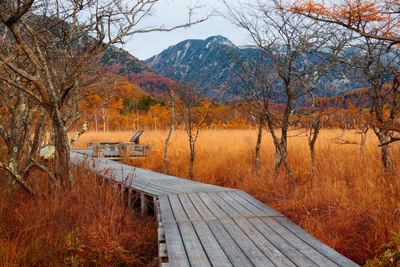
Yunodaira Marsh contains hot spring sources, each protected by a roof.
The marsh is about a 5-minute walk, or around 400 m, from Yumoto Onsen bus stop, with the scent of sulfur drifting through the area.
Water emerging here is supplied not only to inns in Yumoto Onsen but also to Kōtoku Onsen and Chūzenji Onsen.
Boardwalks around the area let you see where the water emerges and appreciate the connection between the hot spring village and its natural surroundings.
Snow can accumulate on the boardwalks in winter, so wear shoes with good traction.
View the sources from the boardwalks and designated paths, and do not touch the equipment or step into the marsh for photos.
Some sources reach nearly 80°C, so keep your hands away from steaming areas and flowing spring water.
Get Walking Information at Nikkō Yumoto Visitor Center
Nikkō Yumoto Visitor Center provides information on Oku-Nikkō’s plants, wildlife, and hiking routes.
A Ministry of the Environment facility, it is free to enter.
From April to November it is open daily from 9:00 a.m. to 4:00 p.m., extended to 5:00 p.m. from July 1 to August 31.
In December and January it closes on weekdays; in February and March it closes on Wednesdays, with opening hours of 9:30 a.m. to 4:00 p.m.
Seasonal nature observation events are also offered, and English webpages are available.
Check trail conditions and bear sighting information before setting out so you can choose a destination suited to the day’s circumstances.
Do not feed wildlife or pick plants, and take your trash away: these are basic principles for spending time in nature.


Oku-Nikkō Yumoto Onsen by Season: Scenery, Clothing, and Winter Tips
The character of a trip to Oku-Nikkō Yumoto Onsen changes with spring growth, summer greenery, autumn leaves, and winter snow.
There is an elevation difference of more than 500 m between Nikkō’s shrine and temple district and Yumoto in Oku-Nikkō, and snowfall may increase as you head into Oku-Nikkō.
Prepare for the local weather and the places you will walk, rather than relying only on clothing suited to the city.
Layer Up from Spring to Fall and Check Autumn Foliage Conditions
Choose walking shoes you are used to wearing and bring a jacket you can easily put on or take off, along with rain gear, so you can adapt to the weather.
Spring comes later to Oku-Nikkō than central Nikkō, with cherry blossoms around Lake Chūzenji peaking around mid-May and zumi crabapple blossoms at Senjōgahara from around early June.
Autumn colors in Oku-Nikkō start around late September, with foliage around Lake Yunoko usually at its best in early to mid-October.
Even if autumn leaves are your main goal, check nature updates for the progress of the colors rather than assuming a fixed peak date.
Here is a seasonal overview of the scenery and key preparations.
| Season | Scenery to Enjoy | Preparation Tips |
|---|---|---|
| Spring | New growth and flowers | Check lingering snow and footing |
| Summer | Lakeside greenery | Carry a jacket and rain gear |
| Fall | Autumn colors in the forest and reflected on the lake | Check foliage progress and temperatures |
| Winter | Snow-covered scenery | Prepare warm clothing and traction |
Watch for Snowy Paths and a Frozen Lake in Winter
In the snow season, bring warm outerwear, gloves, and footwear suitable for snow, even for a walk around the village.
Yumoto is strongly affected by weather from the Sea of Japan side, so it may snow here even when central Nikkō has none.
Rather than relying only on the forecast, check the local inn association’s live camera for current conditions.
Lake Yunoko may freeze over in winter, when mallards and Eurasian wigeons can also be seen.
Do not step onto the ice, even if the lake appears frozen.
Snow can make the state of paths difficult to judge, so confirm where access is permitted and be willing to stop your walk rather than pushing on.
Some facilities and services in Oku-Nikkō close or suspend operations in winter, so check the places you want to visit in advance.
Nikkō Yumoto Onsen Ski Resort, within walking distance of the village, usually operates from late December to the end of March, depending on snowfall.


How to Get to Oku-Nikkō Yumoto Onsen Without a Car: Buses from Nikkō Station
By public transportation, take a Tobu Bus service bound for Yumoto Onsen from JR Nikkō Station or Tobu-Nikkō Station.
The journey takes about 90 minutes and costs 1,950 yen one way.
For a round trip, the 2-day Yumoto Onsen Free Pass is another option, priced at 3,500 yen for adults and 1,750 yen for children.
The pass is sold at Tobu-Nikkō Station Tourist Center and through smartphone services such as NIKKO MaaS.
Checking how train arrival times connect with the bus makes it easier to see how much time you can spend at the hot springs.
Check That Your Bus Is Bound for Yumoto Onsen
Buses in the Nikkō area have several destinations, so confirm the Yumoto Onsen destination before boarding and ride to the final stop.
Yumoto Onsen services travel via Chūzenji Onsen, with some also calling at Kōtoku Onsen, before terminating at Yumoto Onsen.
Some buses terminate at Chūzenji Onsen, so check the destination display or information rather than judging by the boarding point alone.
When using maps or journey planners, save Oku-Nikkō Yumoto Onsen and the official name of your accommodation to help confirm your destination.
On a Day Trip, Plan Your Bathing Time Around the Return Bus
For a day trip, check your preferred return bus first, then decide when to finish bathing, allowing time to change and walk to the bus stop.
Bus timetables vary by season, so consult Tobu Bus information for the timetable valid on your travel date.
English bus timetables are also available.
If visiting other places as well, leave enough time for connections rather than filling the whole schedule with sightseeing along the way.
In winter, snow and road conditions may delay buses, so aiming for one service earlier than originally planned provides a useful buffer for the return trip.
Driving to Yumoto Onsen: Check Winter Road Restrictions and Parking
By car, Yumoto is about 40 minutes from Kiyotaki Interchange on the Nikkō Utsunomiya Road via National Route 120.
The village has free municipal parking, including Yumoto Hondōri North Parking Lot and Yumoto Hondōri Lakeside Parking Lot, although the lakeside lot is unavailable when snow accumulates.
However, Yumoto Ski Resort Parking Lot charges a fee on weekends and public holidays while the ski resort is operating.
Konsei Road, National Route 120 toward Gunma Prefecture, usually closes for winter from noon on December 25 until late April; during this period, reach Yumoto from central Nikkō via Irohazaka.
Snowfall and icy roads remain possible until around mid-May, so prepare winter tires and tire chains.

Onsen Etiquette for First-Time Visitors
Japanese communal baths are shared spaces where visitors use the same bathtubs and washing areas.
Knowing the basic etiquette helps you use them comfortably even when communication is limited.
Wash in the Washing Area Before Soaking in the Bath
In a typical communal onsen bath, you bathe without a swimsuit and use separate places for washing your body and soaking.
Wash and rinse off all soap in the washing area before entering the bath, checking the temperature and enjoying it within your comfort limits.
Sulfur spring water can discolor silver and other metal jewelry, so remove rings and necklaces before bathing.
Long soaks can make you feel overheated, so drink water before and after bathing and take breaks between soaks.
Here are some considerate practices for different situations in a shared bath.
| Situation | What to Do | What to Avoid |
|---|---|---|
| Washing area | Check your surroundings before showering | Splash water onto the person next to you |
| Bathtub | Keep towels and hair out of the water | Dip your towel in the bath |
| Conversation | Speak quietly | Shout or play in the water |
| Returning to the changing room | Dry yourself off | Walk across the floor while dripping wet |
Ask the Facility About Tattoos and Private Baths
If you have tattoos, check the policy of the specific facility in advance rather than assuming one rule applies throughout the hot spring resort.
If sharing a bath with others makes you uncomfortable, ask whether a private bath is available.
Some inns offer 50-minute private use of both an outdoor bath and an indoor bath.
Private bath facilities, reservation procedures, and additional fees differ by property, so explain your preferences and confirm availability.
Avoid Photography in Baths and Changing Rooms
To protect everyone’s privacy, refrain from taking photos or videos in baths and changing rooms, and avoid using your smartphone there.
Even when nobody else is visible, follow the facility’s rules rather than deciding for yourself that photography is acceptable.
Take travel photos of outdoor scenery where photography is permitted, while respecting the privacy of people using the baths.
Final Tips for an Oku-Nikkō Yumoto Onsen Visit
Oku-Nikkō Yumoto Onsen combines day-use bathing in milky-white sulfur water and free footbaths with walks around Lake Yunoko and the spring sources.
For a day trip, confirm bathing admission hours and your return bus; for an overnight stay, check meal and bathing times for a more relaxed visit.
Prepare clothing suited to the season, keep winter trail closures and footbath closures in mind, and enjoy a hot spring trip at your own pace.



Reviews (0)