


Mount Wakakusa (Wakakusa-yama), on the eastern side of Nara Park, is a walking destination where you can climb grassy slopes and look out over the city of Nara.
If you include Mount Wakakusa in your itinerary, allow time to enjoy the views as well as for the walk itself.
A satisfying walk depends not only on how far you go, but also on whether you can enjoy the scenery at your own pace.
Checking whether the mountain is open on your travel date and preparing suitable clothing, supplies, and photography etiquette will make decisions easier, even on your first visit.
Mount Wakakusa Opening Season, Admission Fees, and Access
Before heading to Mount Wakakusa, check the day's visitor information and your return transportation.
Travelers' posts can give you a sense of the atmosphere, but base your decisions on updated information from the operators or local government.
What Is Mount Wakakusa? The 342 m Summit and Its Views
Mount Wakakusa stands 342 m high and covers 33 hectares, with grass covering most of its slopes.
It is also called Mount Mikasa (Mikasa-yama) because its shape resembles 3 stacked hats; from the foot, you climb through the first tier, second tier, and third tier, which is the summit.
At the summit is the historic Uguisuzuka Kofun burial mound, said to date from around the 5th century and considered one of Japan's largest keyhole-shaped burial mounds on a summit more than 300 m above sea level.
The summit offers panoramic views of the Nara Basin, including landmarks in Nara such as Tōdai-ji and Kōfuku-ji temples.
The night view from Mount Wakakusa was selected as one of Japan's “New Three Major Night Views,” and its scenery from evening into night is also well known.
Check Your Travel Date, Opening Season, and Admission Fees
Once your travel date is set, check which days and hours the mountain is open and which areas you can walk in.
Mount Wakakusa's opening season runs from the 3rd Saturday in March to the 2nd Sunday in December, with opening hours from 9:00 a.m. to 5:00 p.m.
Applying this rule to the 2026 calendar, the final day before the seasonal closure is expected to be Sunday, December 13; during the closed season, entry through the gates at the foot is unavailable except on special opening days.
Individual admission is 150 yen for adults (junior high school students and older) and 80 yen for children aged 3 and above; groups of 30 or more pay 120 yen per adult and 60 yen per child.
Presenting a physical disability certificate, rehabilitation certificate, or mental disability health and welfare certificate grants free admission to the holder and 1 accompanying person.
The traditional Wakakusa Yamayaki grass-burning event is held every year on the 4th Saturday of January, during the closed season.
Check fees and any required procedures, rather than assuming conditions described in older travel accounts still apply.
You can confirm the day's opening status on Nara Prefecture's official website or with the Nara Park Office at 0742-22-0375.
If on-site information differs from what you have, follow the notices and staff instructions there.
Plan Your Route to the Mountain Gates and Your Return Journey
When locating your destination on a map, consider where you will start walking and return to, rather than looking up only the place name.
Mount Wakakusa has 2 entrances, the South Gate and North Gate, about 300 m apart.
If arriving by train, take a Nara Kotsu clockwise city loop bus from JR Nara Station or Kintetsu Nara Station, get off at Tōdaiji Daibutsuden/Kasuga Taisha-mae or Kasuga Taisha Omotesandō bus stop, and walk about 15 minutes to the foot of the mountain.
Walking from Kintetsu Nara Station to the foot takes about 30 minutes.
If using public transportation, check your return boarding point and service information, and leave time between your walk and your next plans.
If your group splits up, agree beforehand on how to stay in touch and where to reunite, making clear whether the meeting point is the South Gate or North Gate.
Understand Japanese Signs Before Continuing
If you are not familiar with Japanese, saving the names of your destination and return point on your phone can help when asking for directions.
For example, saving the Japanese spellings for Wakakusa-yama, South Gate, and North Gate makes it easier to compare them with signs on site.
If you encounter signs such as Tachiiri Kinshi (No Entry) or Tsūkōdome (Road Closed), use a translation tool to check the meaning and do not continue until you understand.
If the translation alone is unclear, show the sign when asking a question and confirm where you may pass.


Plan Your Mount Wakakusa Walk with Time and Energy for the Return
To keep your walk manageable, it is important to preserve enough energy for the return, rather than considering only the outward journey.
How Long Does It Take to Walk from the Gates to the Summit?
The walk from the entrance gates at the foot to the summit takes about 30–40 minutes.
The view changes as you climb from the first tier to the second and then the summit, so pausing to look back is one way to enjoy the ascent.
Views open up after even a short climb, but the steep slopes require particular care on the way down.
Even if you turn back near the first tier instead of reaching the summit, allow time and energy for the descent.
Plan around the 30–40-minute climb, adding time for the descent, breaks, and photography.
The mountain closes at 5:00 p.m., so starting late may leave you less time to spend at the summit.
Choose How Far to Walk Based on Your Companions' Pace
If someone is unfamiliar with hill walking, focus on making it easy for them to say they are tired, rather than simply matching everyone's pace.
When visiting with children, agreeing on who will watch them while another adult takes photos helps avoid a scramble.
If planning to use a stroller or wheelchair, check the route's steps, surfaces, and accessible areas before starting.
If walking up from the foot is difficult, another option is to drive along the Shin-Wakakusayama Course of the Nara Okuyama Driveway, then walk about 300 m from the free Wakakusayama Summit Parking Lot to the summit.
The Shin-Wakakusayama Course is a motor-vehicle-only road, so pedestrians and bicycles cannot use it; tolls are 700 yen for kei minicars and standard passenger cars and 500 yen for motorcycles.
From April 1, 2026, Nara Kotsu operates the Wakakusa Hilltop Bus sightseeing service daily between JR Nara Station, Kintetsu Nara Station, and the summit until December 12, 2026, although the 4th service does not run on Saturdays from October 31 to November 28.
Round-trip fares are 2,000 yen for adults aged 12 and above and 1,000 yen for children aged 6–11. The summit stop lasts about 45 minutes but may be shortened by road conditions. You can also take a one-way trip at the same fare, get off at the summit, and walk down during opening hours, with mountain admission charged separately.
Onboard audio guidance is available in Japanese, English, and Chinese, making the bus convenient for travelers who are not confident in Japanese.
If you have more sightseeing planned afterward, choosing a shorter walk can help account for later travel and fatigue.
Allow Time to Enjoy the Views from the Summit
When a view catches your eye, stop somewhere stable where you will not block others, and take in both the distant scenery and your immediate surroundings.
Checking the directions of Tōdai-ji and Kōfuku-ji on a map before reaching the summit lets you look for the buildings in the landscape.
Separating time for photography from time spent viewing the scenery with your camera put away helps you notice what attracts you.
If you start worrying about your return journey, or your companions begin to tire, reconsider plans to continue.


What to Wear and Bring for Mount Wakakusa's Weather
Choose clothing based on comfort for walking and how easily you can add or remove layers, rather than appearance alone.
Prepare Your Shoes and Bags for Sloping Mountain Paths
Choose well-fitting shoes with soles in good condition, and avoid wearing unfamiliar shoes for the first time on your travel day.
Mount Wakakusa has some steep sections, so nonslip sneakers are likely to be more comfortable than sandals or high heels.
Carrying your belongings in a backpack rather than holding them makes it easier to move when you need to watch your footing.
Keep jackets and rain gear within easy reach so you do not need to spread out your belongings when you stop.
Adjust Your Clothing to the Forecast
Even if it is sunny when you leave, check the forecast for the time you will be walking, and reconsider your plans if rain or wind is a concern.
The grassy slopes have little shade, so bringing a hat or other sun protection is a good idea on sunny days.
Grass and earth slopes can become slippery after rain, so take extra care with your footing when descending.
Prepare for heat and cold based on the temperature on your travel date and the time you will be active, rather than general impressions of the season.
The following combinations can help you adjust your preparations to the weather.
| Condition | Clothing and Supplies | How to Use Them |
|---|---|---|
| Strong sunshine | Hat and sun protection | Adjust how much skin is exposed |
| Likely to sweat | Towel and change of clothes | Wipe away sweat and change clothes |
| Chilly wind | Jacket that is easy to add or remove | Adjust layers before and after breaks |
| Rain forecast | Rain gear | Reconsider your route as well |
Prepare Drinks and Small Essentials Before Setting Out
Bring drinks and other necessities before you leave, rather than assuming you can buy them along the way.
There are no shops at the summit of Mount Wakakusa; drinks are available from vending machines, but deer crackers are not sold there.
Before starting, check the battery level of the phone you will use for maps, translation, and photos.
Organizing small items by purpose makes them easier to find when needed.
- For communication: a portable charger for your phone
- For personal use: a handkerchief and tissues
- For cleanup: a bag to take used items home
Do not rely on finding trash cans in Nara Park, and always bring a bag for carrying out your trash.
Checking toilet locations before walking also helps you avoid having to change plans in a hurry.
Facilities may not be available once you start climbing, so using a toilet at the foot before entering is a good idea.


Mount Wakakusa Photography Tips for Nara's Landscapes
You can enjoy landscape photography without moving far by considering what to include in the frame and the direction of the light.
Photograph Both Nara's Skyline and Nearby Details
Start with a wide view of the scenery, then focus on details with colors or shapes that catch your attention to create variety in your photos.
Try changing your main subject by location: capture the breadth of the Nara Basin in a horizontal composition at the summit, or frame the grassy contours and deer in the foreground on the slopes.
Compare photos with plenty of sky against those focused on the landscape below, and choose the composition that best reflects your impression.
For subjects you cannot approach, use zoom or crop your image from permitted walking areas rather than leaving the path for a photograph.
Check Closing Times and Transportation for Sunset and Night Photography
If you are visiting for the night view, remember that the mountain closes at 5:00 p.m., so you cannot start walking up through the gates at the foot after that time.
To see the night view, you can drive along the Nara Okuyama Driveway's Shin-Wakakusayama Course, open from 5:00 a.m. to 11:00 p.m., to the parking lot near the summit.
The exit gate of the Shin-Wakakusayama Course closes at 1:00 a.m., so allow plenty of time to drive down after enjoying the night view.
Even when walking up during the day, compare sunset and closing times if you want to photograph the city in the soft evening light.
The slopes become harder to see at dusk, so begin descending promptly after finishing your photography.
Check Your Surroundings and Footing Before Taking Portraits
When photographing your companions, stop first and check the direction of light on their faces and how the background appears.
Avoid stepping backward while looking at the screen; if you need to move, lower the camera and check your footing first.
Crouching or stepping backward on grassy slopes can easily upset your balance, so both the photographer and the subject should check their footing.
If other travelers would appear prominently in your photo, change the angle or wait for people to pass, and ask permission if you want to make someone your main subject.
Rules for photography equipment vary by location, so check the visitor information before bringing it.
If you want to fly a drone, ask the managers, such as the Nara Park Office, about the rules beforehand rather than deciding for yourself.


Mount Wakakusa Walking Etiquette: Respect Nature and Other Visitors
While walking on Mount Wakakusa, take care of the paths and natural environment and share the space considerately.
Choose Appropriate Places to Walk and Rest
Use permitted walking routes and do not take apparent shortcuts or go beyond fences without permission.
When passing others or taking a break, watch their movements and give way, and check whether you would obstruct the path before spreading out your belongings.
Keep voices and music quiet, and consider those who want to enjoy the scenery peacefully.
Nara Park asks visitors to refrain from ball games, as they can be dangerous.
The table below outlines considerate behavior in situations that may arise while walking.
| Situation | Considerate Action | Action to Avoid |
|---|---|---|
| Passing in a narrow place | Check your footing and give way | Forcing your way through |
| Stopping for a break | Keep the passage clear | Spreading bags across the path |
| Calling your companions | Move closer to speak | Shouting repeatedly |
| After taking a photo | Look around and move on | Continuing to occupy the spot |
Take Your Trash Home and Leave Nature Undisturbed
Put food wrappers and used tissues in the bag you brought, and take them home without letting them blow away.
Trash can make deer ill if they eat it, so it is important not to leave even small pieces on the slopes.
Rather than taking home flowers or stones you find in the scenery, record them in photos or travel notes to share your memories.
If you see wildlife, keep your distance and observe without chasing it or blocking its path for photographs.
Keep a Respectful Distance from Nara's Deer
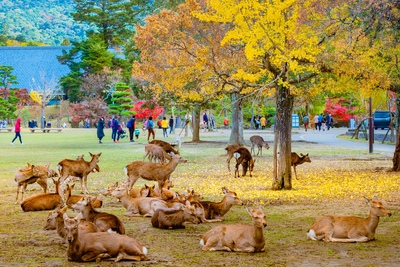
You may see deer from Nara Park on Mount Wakakusa's slopes or summit.
Nara Park's deer are wild animals designated a National Natural Monument, and a survey in July 2026 recorded 1,687 of them.
Do not feed them anything other than deer crackers, hit them, or chase them.
Take particular care in spring, when females protect their young after giving birth, and in autumn, when males enter the mating season and can become aggressive.
If feeding deer crackers, offer them promptly without teasing, and keep an adult close by when small children are present.

Planning Your Mount Wakakusa Walk
Plan your Mount Wakakusa walk by checking visitor information such as the opening season and admission fees, while leaving enough time and energy for your return.
Wear comfortable clothing, bring the essentials, and remember your footing and the people around you when taking photographs.
By choosing a manageable walking distance and pausing for views that catch your eye, you can enjoy your trip at a pace that suits you.


Reviews (0)