


Yaoyorozu Kami no Goten Cherry Blossom Viewing Has Been Suspended Since 2025
At Yaoyorozu Kami no Goten, a religious site known for cherry blossoms in Mima City, Tokushima Prefecture, public access to the grounds during cherry blossom season has been suspended since 2025.
Before planning your itinerary, be aware that travelers cannot enter for cherry blossom viewing, even if the site is introduced as a famous cherry blossom spot.
Public access for cherry blossom sightseeing is suspended, and no reopening date has been set.
Do Not Visit for Cherry Blossom Viewing or Enter the Grounds, Including the Parking Lot
During the cherry blossom season, visits by members of the general public other than people associated with the site and its followers are completely prohibited, and visitors must refrain from entering the grounds, including the parking lot.
Do not include the site in your itinerary even if you only intend to photograph the blossoms from the entrance or parking area.
Cherry blossom information may remain in old travel agency tour listings or personal blogs, but it does not reflect the current visitor arrangements.
Reopening Is Difficult: Check Official Announcements Rather Than Making Inquiries
As reopening remains difficult, please refrain from asking when public access will resume.
With no reopening date set, do not plan a trip on the assumption that access will resume.
If you are considering a visit, read the “Notice of Suspension of Cherry Blossom Sightseeing” on the site's official website and avoid assuming it will reopen until a formal announcement is made.
Reasons for the Suspension: Suspected Witches' Broom Disease, Extreme Heat, and Wildlife Damage
The cherry trees have shown an unusual outbreak of symptoms thought to be witches' broom disease, and care of the trees has continued.
Witches' broom disease (tengusu-byō) is a fungal disease that causes serious damage to cherry trees, including Somei-yoshino.
Recent extreme summer heat, together with digging around the roots and feeding damage by wild boar, deer, and other wildlife, has reportedly made it difficult to continue caring for the trees while opening the grounds during blossom season.
Travelers can help preserve this landscape for the future by respecting the management's guidance.


What Is Yaoyorozu Kami no Goten? Its Location and Cherry Blossom Landscape
Yaoyorozu Kami no Goten is in Wakimachi, Mima City, Tokushima Prefecture, and is known for cherry blossoms covering a mountainside at an elevation of about 400 m.
How to Pronounce Yaoyorozu Kami no Goten and Where It Is
The name is pronounced “Yaoyorozu Kami no Goten.”
It is sometimes also called “Yaoyorozu no Kami no Goten,” so searching both pronunciations in hiragana can make information easier to find.
The address is 1701-2 Higashiakatani-myō, Wakimachi, Mima City, around a 10-minute drive from Wakimachi Interchange on the Tokushima Expressway.
When searching, combining the site's Japanese name with “Mima City” makes it easier to compare tourist information with the operator's announcements.
It is also a place of worship run by the religious corporation Yaoyorozu Kami no Goten, so public access and worship visits are subject to the management's policies.
Around 8,000 Somei-yoshino Cherry Trees Color the Mountainside
The site is known for around 8,000 cherry trees, including Somei-yoshino, blooming across the mountainside and turning it pink.
It has long been a popular cherry blossom spot in Tokushima Prefecture.
Its signature sight is around 8,000 Somei-yoshino trees, tended throughout the year, blooming at an elevation of about 400 m.
The density of the blossoms and the sweep of color following the slopes give the landscape its distinctive character.
When looking at photos of the site, notice how the blossoms spread across the whole mountainside as well as the close-up flowers.


When Do the Cherry Blossoms Bloom? Typical Timing and Public Access Are Different
The usual cherry blossom viewing season is said to be late March to early April.
When the grounds were open to the public, cherry blossom viewing dates were announced around this period according to the state of the blooms.
This timing is a seasonal reference, not a schedule of dates when entry is permitted.
Typical Peak Bloom Dates Do Not Guarantee Blossoms on Your Travel Date
The timing of flowering and when petals begin to fall varies with each year's temperatures and weather.
Choosing travel dates solely from the dates of older full-bloom photos may not match the actual condition of the flowers.
For a spring flower trip in Mima City, check the latest bloom conditions at places you can visit shortly before traveling, and keep options such as town walks available to suit the weather.
Read Bloom Updates Separately from Access Announcements
Terms such as “flowering” and “best viewing time” describe the blossoms, while “open to the public” concerns whether travelers may enter.
A post showing flowers in bloom does not mean that visitor access has resumed.
Here are common cherry blossom terms and what they mean for planning a trip.
| Term | What It Describes | Travel Planning Note |
|---|---|---|
| Flowering | Flowers begin to open | Not necessarily full bloom |
| Full Bloom | Flowers are fully open | Public access is a separate matter |
| Best Viewing Time | A good period to admire the flowers | Varies from year to year |
| Open to the Public | General visitors are admitted | Check the operator's announcement |


What to Know Before Looking Up Yaoyorozu Kami no Goten Directions or Admission Fees
While public access is suspended, do not use older directions or fee information to plan a trip to the site.
Do Not Treat Old Admission Fees or Opening Hours as Current Information
Take care not to confuse the suspension notice with admission fees and opening hours from the period when the grounds were open to the public.
When public access was available, admission was 1,000 yen per person for elementary school students and older visitors.
Older sources give different opening hours, including 8:00 a.m.–6:00 p.m. and 8:00 a.m.–7:00 p.m.; neither applies during the current suspension.
The telephone number has also changed, so do not use numbers from older tourist information without checking.
When sources conflict, prioritize the operator's suspension notice rather than making a decision based only on a quoted price or time.
Do Not Assume Traffic Control Is Available on the Approach Road
There is no alternating one-way traffic control by security staff on the approach road.
When the grounds were open, uphill and downhill vehicles took turns during cherry blossom season to prevent accidents because parts of the approach road are narrow and unimproved.
Even if older blossom-viewing information mentions traffic control, do not expect the same arrangements now.
People associated with a neighboring company also use the approach road, so care is needed to avoid vehicle collisions and other accidents.
The entrance from National Route 193 toward Akatani Bridge is extremely narrow and particularly difficult to turn into when approaching from the north, on the Takamatsu side.
Avoid driving there simply to check the situation or stopping on nearby roads to take photos.
For Travel Without a Car, Choose an Accessible Destination and Plan Your Return First
Even when Yaoyorozu Kami no Goten was open to the public, access was described as a taxi ride of about 15 minutes from Anabuki Station on the JR Tokushima Line.
If using public transport, first confirm that your chosen cherry blossom destination is open to visitors, then research how to get there from the station.
If switching to another attraction, check train and bus timetables and plan your return journey as well.


Basic Cherry Blossom Viewing and Photography Etiquette
When visiting other cherry blossom spots that are open to the public, the basic rules are to protect the flowers and keep routes clear for others.
Check Local Signs to Find Out Where Photography Is Allowed
Rules for photography, tripod use, and taking pictures inside buildings vary by location.
If there are no signs and you are unsure, follow the manager's guidance rather than assuming permission.
Ask people before featuring them prominently in a photo, and avoid blocking paths or entrances for long periods.
Avoid Damaging Cherry Branches, Roots, or Planted Areas
Even if you want a closer look at the flowers, admire them from places where walking is permitted without pulling branches toward you or entering planted areas.
At some famous blossom spots, including Yaoyorozu Kami no Goten, caring for cherry trees has become challenging because of disease and wildlife damage.
Follow your destination's rules on eating, drinking, and handling trash.
At Yaoyorozu Kami no Goten, eating and drinking on the grounds were prohibited even when the site was open to the public.
Here are practical guidelines for situations that can cause uncertainty at cherry blossom spots open to visitors.
| Situation | What to Do | What to Avoid |
|---|---|---|
| Photography | Keep paths clear | Occupying a spot for a long time |
| Viewing Cherry Blossoms | Admire them from a distance | Pulling branches toward you |
| Taking a Break | Use an available designated space | Entering planted areas |
| Handling Trash | Be ready to take it home | Leaving food or drinks behind |

Nearby Places for Spring Flowers and Town Walks in Mima City
If you had planned to see cherry blossoms at Yaoyorozu Kami no Goten, you can rebuild your itinerary around Mima City town walks and flower spots that are open to visitors.
Discover Indigo Merchant History Along Wakimachi's Udatsu Townscape
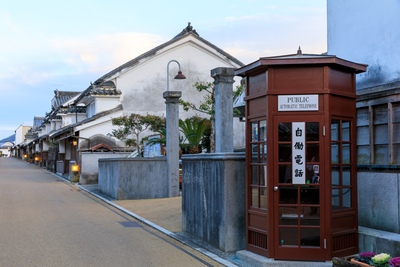
Wakimachi's Udatsu Townscape (Udatsu no Machinami), a historic streetscape, flourished as an indigo trading center during the Edo period thanks to water transport on the Yoshino River; historic buildings from the mid-Edo to early Shōwa periods line about 430 m of streets.
In 1988, it became Japan's 28th nationally designated Important Preservation District for Groups of Traditional Buildings, and the townscape was also included when Awa indigo received Japan Heritage recognition in May 2019.
An udatsu is a plastered projecting side wall on the second story of a building, originally designed as a firebreak.
Over time, these walls became increasingly decorative, and wealthy merchants competed to build them as symbols of prosperity; they also gave rise to the phrase udatsu ga agaranai, meaning to struggle to get ahead in life.
Near the center of the streetscape, the Aishō Sanao Yoshida Residence, a former indigo merchant's home, occupies roughly 600 tsubo (a traditional Japanese unit of area), with 5 buildings, including the main house, a pawnshop storehouse, and an indigo storehouse, arranged around a courtyard.
Standard admission is 510 yen for adults and 250 yen for children, and opening hours are 9:00 a.m.–5:00 p.m., with last entry at 4:30 p.m.; special admission rates may apply during events.
Volunteer guides can explain the udatsu walls and the townscape's history and culture, with tours also available in English and simple sign language.
The stated contribution is 500 yen per person for groups of 1–4, or 2,000 yen per guide for a bus group.
Nearby, the Ai Land Udatsu roadside station has an Aigura shop selling Mima City specialties, indigo-dyed products, and Tokushima souvenirs.
It is also an option for travelers who want a walk less dependent on flower conditions.
See Cherry Blossoms and Tulips at De Rijke Park
De Rijke Park is a place to enjoy both cherry blossoms and tulips.
Around 15,000 tulips usually bloom in early April, offering the opportunity to view both tulips and cherry blossoms.
The park also has a windmill, a symbol of the Netherlands, making it a candidate for a walk among spring flowers.
The park is named after the Dutch engineer Johannis de Rijke, who designed a sediment-control dam on the Ōtani River running through Wakimachi, Mima City.
Check local tourist information for flower conditions before visiting, and follow signs indicating where viewing is permitted.
Adapt Your Itinerary to Your Interests
Sharing preferences such as seeing flowers, taking photos, or discovering local culture with your companions will make it easier to choose an alternative destination.
- For flowers, check which places are open and the latest bloom information.
- For a town walk, consider the Udatsu Townscape.
- If transport is a concern, limit your destinations and arrange the return journey first.
Do not assume from a map alone that mountain cherry blossom sites and flowers in town are within walking distance of each other; checking transport to each will help you plan a manageable trip.
Planning a Spring Visit to Mima City
Yaoyorozu Kami no Goten is a Mima City landmark where around 8,000 cherry trees color the mountainside, but public access during cherry blossom season has been suspended since 2025.
Avoid visiting on the assumption that it will reopen or entering the grounds, and respect the site's official announcements.
For a spring trip, choose places you can visit, such as the Udatsu Townscape or De Rijke Park, and plan to enjoy Mima City's scenery and culture.


Reviews (0)