


Kokura Castle in Kitakyushu: Choose What You Want to See
If you are adding Kokura Castle (Kokura-jō) in Kitakyushu to your itinerary, consider whether you want to admire its karazukuri-style keep, with its projecting top floor, and stone walls, explore its history, or take photographs.
Hosokawa Tadaoki began full-scale construction of Kokura Castle in 1602, the 7th year of the Keichō era, and it is now the only castle in Fukuoka Prefecture with a castle keep.
All 5 floors of the keep feature exhibitions, hands-on activities, and an observation area, letting you enjoy the building's exterior, historical displays, and the view from the top floor in a single visit.
Choosing a theme that interests you will make it easier to pick out the most suitable things to see from the information available on site.
Choose Your Focus: Architecture, History, or Photography
If you enjoy architecture, focus on shapes and materials; if you like history, look for people and events; and if photography is your interest, pay attention to composition.
Distinctive Kokura Castle themes include the keep's karazukuri architecture and nozurazumi walls of uncut stone, the eras of the Hosokawa and Ogasawara clans, and photographs combining the keep with a torii shrine gate or pond.
Even without specialist knowledge, asking yourself which shapes catch your eye or why the castle was built here gives you a reason to explore the explanations.
If your companions have different interests, tell one another beforehand what you would like to stop and see, making it easier to include everyone's preferences.
The keep's 1st floor offers costume experiences and a yabusame mounted archery game, while the 4th floor has an XR escape game, making it easier for people who want to read displays carefully and those who prefer activities to spend time in different ways.
The 1st-floor video theater takes about 10 minutes and the 4th-floor XR escape game about 30 minutes, so allow extra visiting time if you want to try the activities.
Check Kokura Castle Opening Hours, Admission Fees, and Ticket Coverage
Before leaving, check the castle's official information to confirm opening arrangements and admission conditions for your visiting date.
Regular opening hours are listed as 9:00 a.m.–8:00 p.m. from April through October and 9:00 a.m.–7:00 p.m. from November through March, with the castle open every day.
Hours may vary on individual days because of events or private bookings, so also check the official website's upcoming opening hours and notices.
Opening hours and the admission cutoff do not necessarily mean the same thing, so reading them as separate items makes scheduling easier.
Last entry to Kokura Castle is 30 minutes before closing, so leave enough time to arrive if you plan an evening visit.
When buying a ticket, check the areas and dates it covers and choose one that matches what you want to see.
Admission to the keep is 500 yen for adults, 300 yen for junior high and high school students, and 150 yen for elementary school students; preschool children enter free.
An adult combination ticket for 2 attractions, including Kokura Castle Garden, costs 700 yen, while a 3-attraction ticket adding the Matsumoto Seichō Memorial Museum costs 900 yen, so compare the combination tickets if you also want to visit nearby facilities.
Tickets can be purchased on the day at each attraction's ticket counter or in advance online through KKday.
The XR escape game on the keep's 4th floor and the tea ceremony experience at Kokura Castle Garden do not require reservations, although the XR escape game can also be booked in advance online.
For reservation requirements and photography conditions, use official information and ask about anything unclear rather than relying solely on travelers' posts.
For inquiries, call 093-561-1210 for the keep and Shiro Terrace, or 093-582-2747 for Kokura Castle Garden.


Kokura Castle Architecture: From the Keep's Silhouette to Its Stone Walls
When looking at a castle building, start with its overall silhouette before moving on to details such as the roof and walls to better appreciate differences in shape.
At Kokura Castle, looking first at the shape of the upper keep and then at the stone walls supporting the castle makes its distinctive features easier to notice.
View the Karazukuri Keep From a Distance
From somewhere you can stop safely, move your eyes from the top of the building to the bottom, observing the layers of roofs and their balance with the walls.
Kokura Castle's keep is built in a style called karazukuri, with no projecting roof eaves between the 4th and 5th floors and a 5th floor larger than the 4th.
This is a rare form of castle keep in Japan, so step back to see how the top floor projects outward.
Then broaden your view to observe how the building connects with the paths around it for a different impression from the one you get up close.
Another way to appreciate the shape is to change your viewing angle within accessible areas and compare the front and diagonal views.
The keep is said to rank 6th in Japan for height, and the castle was once regarded as Kyushu's largest, with the 5th-largest overall scale in Japan.
Compare Nozurazumi Stone Walls and Roof Shapes Without Touching
Putting the features you notice into words, such as stone sizes and arrangements, roof lines, and wall colors, can deepen your observation.
Kokura Castle's walls use nozurazumi, a construction method that stacks natural stones from the Mount Adachi area without cutting them into uniform shapes.
The surface of interlocking stones of different shapes and sizes has a rustic yet bold appearance, preserving the craftsmanship of the castle's construction era.
Some stones retain carvings of the manji (卍) symbol, so looking for these from the visitor path is another way to enjoy the walls.
If you become curious about materials or construction methods, look for an on-site explanation rather than judging their age or technique by appearance alone.
Avoid leaving the visitor path to inspect details, and use a handheld camera's zoom or similar means to view areas you cannot approach.
Useful Japanese Castle Terms: Keeps, Stone Walls, and Moats
Information about Japanese castles uses terms for particular buildings and divisions of the grounds.
Check on-site guidance for Kokura Castle's layout and accessible areas, and learn these terms as useful background for castle visits in general.
The table below explains terms you may encounter and what to look for when viewing them.
| Term | General Meaning | What to Look For |
|---|---|---|
| Tenshu: castle keep | A tall building symbolizing the castle | Overall silhouette and roofs |
| Ishigaki: stone walls | Walls made of stacked stones | Stone shapes and how they fit together |
| Hori: moat | A defensive ditch | Its position relative to buildings and paths |
| Jōkamachi: castle town | A town that developed around a castle | The relationship between castle and town |
Using the terms as clues, compare what you can actually see with the site map to better understand the space around the castle.
The outer moat surrounding Kokura Castle's castle town extended for about 8 kilometers, connecting present-day Sunatsu, Nakatsuguchi, Kawaraguchi, Bungobashi, Kanada, and Tatemachi.
Looking up these place names in a map app makes it easier to imagine the size of the town that spread out around the castle.


Understanding Kokura Castle History Through Connected Events
Even if Japanese history is unfamiliar, following who did what and how things changed afterward provides a way into the castle's past.
For your research before visiting Kokura Castle, try narrowing down what you want to know rather than increasing the amount you need to memorize.
Focus on the Roles of Hosokawa Tadaoki and the Ogasawara Clan
If an unfamiliar name appears in an explanation, first work out that person's role, such as whether they built or governed the castle.
The names that appear especially often in Kokura Castle's story are Hosokawa Tadaoki, who built the fully developed castle, and the Ogasawara clan, who later became its lords.
Hosokawa Tadaoki is said to have built the castle over about 7 years starting in 1602, developed the castle town, and established the Kokura Gion Festival.
After Ogasawara Tadazane arrived in 1632, the 9th year of the Kan'ei era, the castle served as the Ogasawara clan's residence for 234 years until the end of the shogunate.
The keep's 3rd floor also introduces Miyamoto Musashi and Sasaki Kojirō, whose duel on Ganryūjima in 1612, the 17th year of the Keichō era, took place during Hosokawa rule in Kokura.
Instead of trying to remember every relationship between the people involved, focus on the changes they brought to the castle and town to follow the story more easily.
Writing down the names of people who interest you can also help when revisiting official explanations after your trip.
Distinguish the Keep Rebuilt in 1959 From Earlier Historical Periods
When reading historical explanations, it is also useful to distinguish the building in front of you from the period described in the text.
At Kokura Castle, the keep built by Hosokawa Tadaoki burned down with the honmaru main enclosure in 1837, the 8th year of the Tenpō era, and the keep was not rebuilt during the Edo period.
The present keep was rebuilt in 1959, the 34th year of the Shōwa era, in response to citizens' wishes.
Its exhibits and facilities have continued to be updated through a complete renovation in 1990 and a major interior renewal in 2019.
When you see terms such as “foundation,” “reconstruction,” and “restoration,” use the surrounding text to check what was built and what was repaired.
If old plans or photographs are available, establish which period they depict before comparing them with the castle's present appearance.
A model reproducing the former keep is also displayed on the 2nd floor, providing a reference for comparison with today's exterior.
Then look for features that remain and parts that have changed to appreciate both the building itself and how the castle has been passed down.
Distinguishing the stone walls that preserve original construction techniques from the keep rebuilt in the Shōwa era makes the layers of Kokura Castle's history easier to understand.
A Timeline of Major Events at Kokura Castle
Putting the main events in chronological order before reading the on-site explanations helps you place the exhibits in context.
- 1569: The Mōri clan first builds a castle on the present site.
- 1602: Hosokawa Tadaoki begins full-scale construction, taking about 7 years to build a castle with a karazukuri-style keep.
- 1632: Ogasawara Tadazane arrives, and the castle becomes the Ogasawara clan's residence until the end of the shogunate.
- 1837: A fire starting inside the castle destroys the keep and main enclosure.
- 1866: During the Kokura War against the Chōshū domain, the Kokura domain retreats and the castle also burns down.
- 1959: The keep is rebuilt in response to citizens' wishes.
- 2019: A major renewal of the keep's interior updates its exhibitions and facilities.
Even without memorizing the dates, understanding the sequence of construction, destruction by fire, and reconstruction makes the local explanations easier to follow.


Kokura Castle Photography: Check Permission and Consider Others
The starting point for taking enjoyable travel photographs is to check where photography is allowed and under what conditions before pointing your camera.
Check Permitted Areas and Equipment Rules
Where photography permission is unclear, read the signs or ask a staff member.
Conditions may differ for photos, video, flash, tripods, and selfie sticks, so ask specifically about the equipment you want to use.
If you are planning media coverage, product photography, or other work beyond personal souvenir photos, contact the facility beforehand to ask whether an application is needed.
Kokura Castle Garden is also used for location shoots such as pre-wedding photographs in Japanese attire, so consult the garden as well if you are considering a professional-style shoot.
Photograph Both the Whole Keep and Its Details
Where photography is permitted, alternate between images of the whole building and close compositions of shapes that interest you to add variety to your record of the visit.
For a photograph of the entire keep, stand a little farther back and include the top in the frame so the projecting 5th floor characteristic of karazukuri architecture is visible.
Check that roofs and other features are not awkwardly cut off at the edges, and compare vertical and horizontal compositions.
Stepping backward while looking at your screen reduces your awareness of your footing, so lower your camera before changing position.
Kokura Castle Photo Spots: Torii Gates and the Nozoki Pond
A place where you can photograph a castle keep together with a shrine torii gate is considered a rare photo opportunity in Japan.
Yasaka Shrine stands within the castle grounds, and looking for a composition of the keep through its torii gate is also recommended.
Kokura Castle Garden, also within the grounds, has a Nozoki Pond set lower than its surroundings, where you can photograph the keep and sky reflected in the water.
The keep's 3rd floor has a photo spot recreating the duel on Ganryūjima, offering a chance for souvenir photographs indoors as well.
The 5th-floor observation area overlooks the town below and the waters around the Kanmon Strait, so be sure to capture the views from the keep too.
The keep is illuminated every day from sunset until 10:00 p.m., offering another way to photograph it from dusk into the evening.
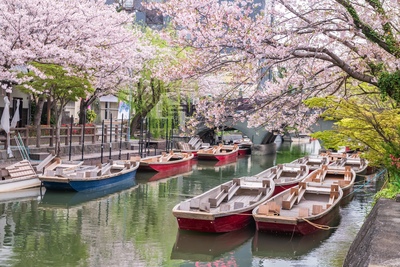
In spring, around 300 cherry trees bloom across the castle area and Katsuyama Park, usually allowing photographs of the blossoms with the keep from late March to mid-April.
Be Considerate of Other Visitors and Cultural Properties
When making a person the main subject, get their permission, and adjust your composition if other people appear prominently in the frame.
Even when discussing a shot with your companions or concentrating on photography, occasionally check the movement of other visitors around you.
Cherry blossom season and illumination hours tend to be busy, so take extra care about where you set up a tripod or stop to take photographs.
The following table summarizes considerate behavior for different situations during a castle visit.
| Situation | Considerate Action | What to Avoid |
|---|---|---|
| Where people are walking | Stop without obstructing traffic | Standing side by side and blocking the path |
| Near stone walls or fences | View them from the visitor path | Climbing or crossing over them |
| At an information panel | Make room after reading | Occupying the space for a long time |
| Near exhibits | Check instructions before touching | Touching without permission |

What to Prepare for an Easier Visit to Kokura Castle
Castle sightseeing during a trip to Japan is easier if you prepare short Japanese questions for things you may need to check and plan a walking pace that suits your companions.
Save the Japanese Facility Name and Prepare Short Questions
Save the Japanese name for Kokura Castle, “小倉城,” on your smartphone so you can use it when searching maps or asking for directions.
It is pronounced “Kokura-jō,” and the keep's address is 2-1 Jōnai, Kokurakita Ward, Kitakyushu, Fukuoka Prefecture.
If you need explanations in another language, check the available languages and how to use them before visiting.
If you are unsure which languages the exhibitions support, calling the keep at 093-561-1210 beforehand will help you plan your visit.
Keep each question focused, showing the facility name or a sign as needed to help make yourself understood.
- May I take photographs here?
- Can visitors go beyond this point?
- Which way is the exit?
Even when using a translation app, if you do not understand a condition in the reply, clarify it by pointing or another method rather than making assumptions and proceeding.
Prepare for Your Companions' Mobility Needs
Wear shoes you are used to walking in and keep your belongings organized so you can focus on getting around and sightseeing.
On days when rain or heat is a concern, adjust what you bring to the forecast and avoid packing too much outdoor walking into your schedule.
If using a stroller or wheelchair, check with the facility beforehand about step-free routes and accessible areas.
During the 2019 renovation, an elevator serving all 5 floors was installed in the keep, allowing travel from the 1st floor to the observation area on the top floor.
A wheelchair-accessible restroom is available; ask the facility beforehand about wheelchair loans and the availability of a baby-changing table.
Check the locations of rest areas and restrooms on arrival, and adjust the itinerary to the pace of companions who find walking difficult for a more manageable visit.
Shiro Terrace, immediately below the keep, offers souvenirs, a tea shop, and gojōin commemorative castle seals, and can be visited before or after exploring the castle.


How to Get to Kokura Castle and What to See in the Grounds
Kokura Castle is in central Kitakyushu, in a location that is easy to reach on foot from nearby stations.
Walking From JR Kokura and Nishi-Kokura Stations, Buses, and Parking
Kokura Castle is about a 15-minute walk from JR Kokura Station and about a 10-minute walk from JR Nishi-Kokura Station.
If traveling by bus, get off a Nishitetsu Bus or Kitakyushu City Bus at the Kitakyūshū Shiyakusho-mae bus stop, about a 1-minute walk from the entrance to Katsuyama Park.
Drivers are directed to the paid Katsuyama Park parking lot beside the Matsumoto Seichō Memorial Museum, with space for 25 standard cars, costing 200 yen for the first hour and 100 yen for each subsequent 20 minutes.
This lot cannot accommodate vehicles 5 meters or longer or 2 meters or wider, so check beforehand if you are traveling in a large vehicle.
Places in the Castle Grounds to Visit Alongside the Keep
Several attractions around Kokura Castle can be combined with a visit to the keep.
- Kokura Castle Garden: A feudal lord's strolling garden around a pond, recreated on the site of the Ogasawara family's secondary residence; the seated table-style tea area offers a tea ceremony experience without reservations for 2,000 yen per person, from 10:00 a.m. to 4:00 p.m., closed December 28–31.
- Shiro Terrace: A visitor hospitality hub immediately below the keep, selling souvenirs and gojōin castle seals.
- Yasaka Shrine: A shrine within the castle grounds whose stone torii gate is a Fukuoka Prefecture-designated Tangible Cultural Property.
- Matsumoto Seichō Memorial Museum: Opened in the castle grounds in 1998 alongside Kokura Castle Garden, and accessible with the 3-attraction combination ticket.
Choose which attractions to combine according to your interests, and check which facilities a combination ticket includes before buying it.
Plan Your Kokura Castle Visit Around Your Interests
When visiting Kokura Castle, deciding on a theme gives your visit a focus, whether you want to explore the karazukuri keep and nozurazumi walls, the history of the Hosokawa and Ogasawara clans, or photographs featuring torii gates and the Nozoki Pond.
Knowing a little castle terminology and how to read the explanations provides clues to understanding what catches your attention on site.
Check opening arrangements and conditions of use before visiting, and give priority to on-site signs and staff instructions on the day.
Be considerate of those around you, prepare for comfortable walking, and enjoy exploring the castle at your own pace.


Reviews (0)