


What to Look for at Keta Taisha
Keta Taisha, located in Hakui, Ishikawa Prefecture, has long attracted worshippers as the foremost shrine of Noto Province.
Instead of rushing straight to your wish, move from the sacred gate toward the shrine buildings while noticing how the space and architecture change, then turn your attention to the forest preserved beyond them. This sequence brings the shrine grounds into clearer, three-dimensional focus.
Discover Layers of Faith at the Gateway to Noto
Ancient records and rituals, donations by successive patrons, and protection by the Kaga Domain all tell how Keta Taisha was valued in different eras.
You do not need to memorize every detail in advance. It is enough to keep in mind that this is an ancient shrine where both the buildings and the forest carry its religious heritage.
The Enshrined Deity and How to Approach Your Prayer
The main sanctuary enshrines Ōnamuchi no Mikoto. Worshippers pray here for many blessings, including good relationships, recovery from illness, traffic safety, safe travel and voyages, conception, and safe childbirth.
Rather than treating these blessings as a checklist, put into words the relationships and way of life you value now before offering your prayer. This gives your time at the shrine a clear purpose.


Understand the Shrine's History and Its Sense of Time
Keta Taisha's history spans ancient state rituals, medieval rebuilding of shrine structures, and protection by the Kaga Domain in the early modern period.
The following table organizes key events by era, helping you see the buildings and forest not as isolated attractions but as part of an unbroken tradition of worship.
| Perspective | What the history reveals | What to notice on site |
|---|---|---|
| Ancient period | The shrine appears in historical records and was an important ritual site in Noto | Its status as the foremost shrine of Noto Province |
| Medieval period | Wakamiya Shrine was rebuilt and survives today | The small sanctuary beside the main sanctuary |
| Early modern period | The Maeda family continued to revere the shrine and commission buildings | The arrangement of the main sanctuary, worship hall, and Hakusan Shrine |
Keta Shrine in the Man’yōshū
A poem written when Ōtomo no Yakamochi visited in 748, the 20th year of Tenpyō, appears in the Man’yōshū. It is considered the earliest appearance of Keta Taisha in literature from the central government.
Imagining the sea at Hakui described in the poem offers a clue to how the shrine was connected not only with the hills but also with travel and daily life along the Sea of Japan.
Warrior Patronage and the Preservation of the Shrine Buildings
From the medieval period onward, provincial governors and warriors continued to donate to and build at the shrine, which also received deep reverence from the Maeda family.
The surviving structures were not all built at once. Comparing their dates and sizes reveals how multiple periods coexist within the grounds.


Compare the Important Cultural Property Shrine Buildings
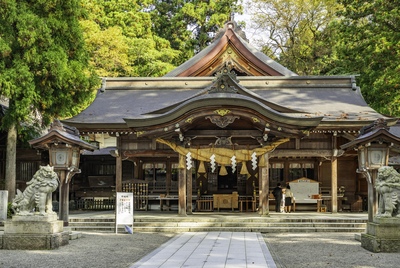
Within the grounds, you can see several buildings designated as Important Cultural Properties of Japan, including the main sanctuary, worship hall, sacred gate, Hakusan Shrine, and Wakamiya Shrine.
The main sanctuary has a ryōnagare-zukuri roof that descends at both the front and rear. This rare form is said to be found only here and at Itsukushima Shrine.
Respect all access restrictions and photography guidance in this sacred setting. Observe the roofs, pillars, and placement of the buildings from positions that do not disturb worshippers.
The table below provides a starting point for comparing the main structures.
| Building | Feature to notice | Viewing tip |
|---|---|---|
| Sacred gate | Its four-legged gate form and curved roofline | View the entire outline from the front |
| Worship hall | Its composition based on Chinese-derived architectural style | Look at how the pillars, doors, and roof form a whole |
| Main sanctuary | The rare ryōnagare-zukuri style | Check the roof shape beyond the worship hall |
| Wakamiya Shrine | A small sanctuary preserving Warring States-period architecture | Compare its scale with the main sanctuary |
Guide Your Gaze from the Sacred Gate to the Worship Hall
At the entrance, first observe the sacred gate's sturdy timber framework and gabled roofline. Then look ahead to the worship hall to sense how the gate marks the boundary of the sacred precinct.
At the worship hall, notice the front doors, the veranda on all four sides, and the direction of the roof. Consider how this open place of worship relates to the main sanctuary beyond it.
View the Main Sanctuary and the Auxiliary Shrines as a Group
Behind the worship hall, the main sanctuary stands in the center, with Wakamiya Shrine and Hakusan Shrine on either side.
Do not focus only on the large central building. Comparing its height, width, and roof with the structures on either side makes it easier to understand how the grounds accommodate several deities.
Take in the Overall Layout Before the Details
Even without specialist knowledge of carvings or structural components, you can appreciate the basic spatial organization of shrine architecture by following the sequence from gate to worship hall to main sanctuary.
Instead of stopping for long periods with binoculars or a telephoto lens, observe briefly while keeping other visitors' paths clear, then change position if needed.


Look Up at Irazunomori from Its Boundary
Irazunomori, the sacred forest spreading behind the shrine buildings, symbolizes Keta Taisha and has long been protected as a divine precinct.
The forest is designated a Natural Monument of Japan and covers 26,299 square meters.
Entry is restricted because it is sacred ground. Even the priests are said to pass through only once a year for a ritual at the inner sanctuary within the grove.
This is not a place to enter like a sightseeing trail. The proper way to encounter the forest is to remain outside its boundary and sense its presence and continuity with the shrine buildings.
The Fact That You Cannot Enter Has Meaning
Do not see the inability to enter the forest as something missing from your visit. Understand it as an expression of faith that has protected the sacred area by limiting human use.
Quietly notice the height of the trees, how the light reaches them, and how the atmosphere differs from the worship hall side. These impressions can convey the sense of a boundary more powerfully than an information board alone.
Do Not Collect Plants or Leave the Path
Around the forest, do not take branches, leaves, or fallen foliage. Follow fences and signs, and view it only from designated areas.
Prioritizing the continuation of its religious and natural heritage over the desire for a closer look is a concrete way for visitors to show respect.


Plan a Quiet Visit
At Keta Taisha, it is better to prepare yourself at the entrance, offer your prayer, and then look over the grounds again than to hurry straight to the main sanctuary and back.
When it is crowded, do not occupy one place for too long. Remember that people praying, observing the architecture, and receiving formal prayers all share the same space.
Put Your Wish into a Few Words Before Worshipping
Check the on-site guidance for purification and worship etiquette, and condense your wish into a few words before approaching the deity.
If you pray for good relationships, do not limit your wish to finding a partner. Thinking about the ties you want to nurture—with family, friends, work, or the community—will make your prayer more specific.
Follow Same-Day Guidance for Festivals and Formal Prayers
Festival schedules, rituals, reception for formal prayers, and conditions for using the grounds may change from day to day, so check announcements before your visit.
If your visit coincides with a special event, do not insist on your usual sightseeing plan. Follow the priests' instructions and posted notices, and adjust where and in what order you visit.

Check Transportation and Site Information Before Visiting
Keta Taisha is in Jike-machi, Hakui. It is about 10 minutes by car from Hakui Station and about a 7-minute walk from the Ichinomiya bus stop.
Travel times and connections vary with timetables, road conditions, and local service circumstances, so it is important not to fix your itinerary using old information alone.
Check Both Directions When Using Public Transportation
If you use public transportation, check not only the train to the nearest transport hub but also the connection to the shrine and your return service at the same time.
On days when services are infrequent, decide your time at the shrine in advance and prioritize worship, observing the buildings, and looking toward the forest.
Adjust Your Plans for the Weather and Ground Conditions
Rain, wind, heat, and cold can affect how easy it is to walk around the outdoor grounds. Choose slip-resistant shoes and clothing suited to the season.
If access areas or transportation change, follow local signs and service information. End your visit within safe limits rather than forcing yourself to complete every planned activity.
Summary | Respect Both the Shrine Buildings and the Forest
Keta Taisha's appeal lies in how its long history as the foremost shrine of Noto Province, Important Cultural Property buildings from different periods, and the protected Irazunomori behind them all come together within one precinct.
Take in the layout from the sacred gate, compare the buildings after worshipping, and quietly look toward the forest while respecting its boundary. This creates a visit that goes beyond simply collecting sights.
Transportation, festivals, formal prayers, and permitted worship areas may change. Check guidance before departure and again on site, and visit with consideration for everyone sharing this place of faith.



Reviews (0)