


Okinawa's Hidden Gems: Explore the Sea and Local Life Together
If you want to find peaceful scenery at Okinawa's hidden gems, look beyond the fame of well-known beaches and seek out places where you can observe how the shore and local villages connect.
A Hidden Gem Does Not Mean an Empty or Safe Place
How quiet a place feels varies with the day of the week, time of day, and season. The term does not guarantee an uncrowded visit, so stay flexible and move to another beach or viewpoint if it is busy.
Even beaches that look deserted can have waves, currents, dangerous wildlife, and sudden changes in weather, and some natural coastlines have no lifeguards or swimming facilities.
Do not assume you will be able to swim. When sea conditions are poor, switch to a walk or enjoy the views, and always give priority to local signs and the guidance of those managing the area.
Compare 10 Beaches, Villages, and Outlying Islands
Travel conditions differ greatly between the north and south of the main island and the surrounding islands, so it makes more sense to spend time in each region than to pack them all into the same itinerary.
| Area | Spot | Highlights |
|---|---|---|
| Northern main island | Kise Beach | White sand and Nago Bay |
| Northern main island | Kōki Beach | Shade beneath casuarina trees |
| Northern main island | Bise Fukugi Tree-lined Lanes | A village surrounded by windbreak trees |
| Southern main island | Hyakuna Beach | A natural coastline and local legends |
| Southern main island | Mībaru Beach | Shallow waters and a sandy beach |
| Central main island | Hamahiga Island | Red roof tiles, stone walls, and places of worship |
| Off Nanjō City | Kudaka Island | Sacred sites and legends of the sea |
| Around Okinawa's main island | Tonaki Island | White-sand lanes and fukugi trees |
| Around Okinawa's main island | Iheya Island | Mountains, villages, and blue seas |
| Around Okinawa's main island | Izena Island | History connected with King Shō En |

Slow Down by the Sea at Kise and Kōki on Nago Bay
On the west coast of the northern main island, taking time to look out at the sea from the shade or walk along the sand, instead of focusing only on swimming, helps you notice changes in the scenery.
Kise Beach: White Sand and the Curve of the Bay
Rather than rushing from one end of the shore to the other, notice how the curved beach, cape, and horizon fit together to appreciate this setting embraced by Nago Bay.
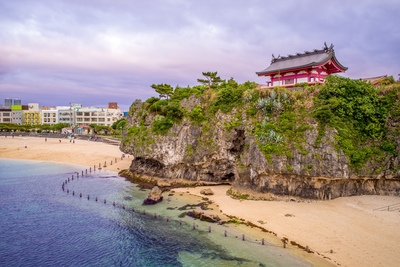
Kise Beach is a natural sandy beach overlooking Cape Busena. The shoreline continues to neighboring Kōki Beach, offering views around Nago Bay.
Bankoku Shinryōkan stands on Cape Busena in front of you and, together with Nago Bay's coastline, serves as a landmark for getting your bearings.
Facilities and conditions of use change with the time of year, so if you plan to swim or try an activity, check the conditions for that day before visiting.
Kōki Beach: The Contrast Between Tree Shade and Reefs
At Kōki Beach, white sand and rocky reefs stretch beyond the shade of casuarina trees, allowing you to observe a characteristic Okinawan coastline without entering the water.
Choose a place to rest out of the strong sun before you set off, and keep track of where the tide will rise and your route back as you walk, so you can enjoy your time without rushing to take photos.

Discover Village Wisdom in Bise and on Hamahiga Island
Fukugi trees, stone walls, and red roof tiles are more than beautiful scenery: they are also part of the ways people have protected their homes and lives against winds and typhoons.
Bise's Fukugi Trees: Woodland Around Local Homes
Noticing how the wind and light change as you enter the village from the sea makes it easier to understand that these tree-lined lanes were a practical environment surrounding homes, rather than decoration.
Bise is known for its grid of streets and the fukugi trees surrounding its homes. The trees have been used as windbreaks to soften the strong coastal winds.
Many fukugi trees grow throughout the village, and the continuous belts of trees around homes have helped protect life in this typhoon-prone area.
The tree-lined lanes are also part of residents' everyday living space. Stay out of private home grounds, avoid photography that blocks passage and loud voices, and quietly enjoy the patterns of light and shade created by the lanes and greenery.

Hamahiga Island: 2 Villages and Places of Prayer
Hamahiga Island has the villages of Hama and Higa, where red-tiled houses, stone walls, and scenery reflecting a life combining farming and fishing remain.
The island has legends associated with the deity of Ryukyuan creation and is dotted with places of worship and sacred sites called utaki. Respect no-entry signs and avoid treating places of prayer as tourist facilities.


Discover Sea Legends at Hyakuna, Mībaru, and Kudaka Island in the Nanjō Area
Looking from the east coast of the southern main island toward Kudaka Island reveals the sea as both beautiful scenery and a setting for stories of the region's origins.
Explore Hyakuna Beach and Mībaru Beach Separately
Although the 2 beaches are close, their management and facilities may differ. Read the signs at each beach rather than assuming information about one applies to the other.
Hyakuna Beach is a natural coastline with a legend of Amamikiyo coming ashore. Visitors are advised that there are no lifeguards, so even when enjoying the scenery, take care not to get too close to the water's edge.
Nearby Mībaru Beach is known for its shallow waters and sand, but this is also a natural marine environment. Check the weather and sea conditions and put safety first.


Learn Kudaka Island's Rules Before Exploring
Kudaka Island has long been called the Island of the Gods. Alongside legends of places such as Ishiki Beach and Cape Kabēru, its utaki and places of worship are carefully protected.
Some places are off-limits, and the island has its own rules. Check them before departure, do not take home stones, sand, or plants, and do not enter places if you are unsure whether access is allowed.


Enjoy Island Time on Tonaki, Iheya, and Izena
On islands reached by boat, room in your schedule to handle cancellations or changes, and respect for village life, matter more to the quality of your trip than the number of sights you visit after arrival.
Tonaki Island: Walk Through White-Sand Lanes and a Fukugi-Lined Village
Instead of looking only for tourist attractions the moment you arrive at the port, slowly follow the continuous scenery of white-sand lanes, trees around homes, and red roof tiles to understand why the island as a whole has been preserved.
Tonaki Island retains red-tiled houses and fukugi trees around homes, and the entire village has been designated a national Important Preservation District for Groups of Traditional Buildings.
The white-sand lanes are part of a living landscape that residents maintain and protect. Keep your voice down early in the morning and at night, and remember that people live here before pointing your camera at a house.
Iheya and Izena: Stay on 1 Island at a Time
On Iheya Island, mountains, traditional villages, and blue seas lie close together, making it a place to explore nature and history slowly on 1 island.
Izena Island offers historic sites connected with King Shō En, villages, and beaches. Transport on the islands is limited, so rather than linking both in a single day, plan to secure boats and local transport for each island in advance.


Plan a Trip That Protects Quiet Shores and Villages
When exploring Okinawa's hidden gems, putting safety and consideration for local communities before efficiency, and keeping your travel area compact, can ultimately make your stay more rewarding.
Explore the North, Center, and South of the Main Island on Separate Days
Grouping Kise, Kōki, and Bise into a northern day, Hamahiga Island into a central day, and Hyakuna, Mībaru, and the Kudaka Island area into a southern day can reduce long drives and the urge to rush.
| Trip focus | Places to combine | Things to keep in mind |
|---|---|---|
| Northern main island | Kise, Kōki, and Bise | Allow for strong sunshine and leave plenty of travel time |
| Central and southern main island | Hamahiga, Hyakuna, and Mībaru | Check sea conditions and local residential roads |
| Surrounding islands | Kudaka, Tonaki, Iheya, and Izena | Make 1 island the focus of 1 itinerary |

Recheck Boats and Sea Conditions Just Before Departure
Departure ports differ by route. Put the port name, boarding procedures, and return service in 1 note, and arrange your plans so that changes do not put strain on your accommodation or transport arrangements.
Weather can cause changes or cancellations on island routes. Check the operator's announcements both the day before and on the day of travel, and have alternatives ready, including for your return journey.
On natural coastlines, avoid going alone and check swimming areas and lifeguard arrangements. In villages, take your trash with you and avoid blocking residents' routes when parking or taking photos.

Final Thoughts: Visit Okinawa's Shores and Villages Quietly
To appreciate the peaceful appeal of Okinawa's hidden gems, explore the shores of Kise and Hyakuna, the villages of Bise and Hamahiga, and the islands of Kudaka, Tonaki, Iheya, and Izena thoughtfully as separate areas, while checking sea safety, sacred-site rules, residents' daily needs, and boat service information.




Reviews (0)