


Sesshō-seki Killing Stone: Nasu Yumoto's Nine-Tailed Fox Legend
The Killing Stone (Sesshō-seki) is a historic site near Nasu Yumoto Onsen in Nasu, Tochigi Prefecture, known for the legend of a nine-tailed fox.
Its rocky landscape brings together prayers associated with the Sentai Jizō statues (images of the Buddhist guardian of travelers and children) and memories of poet Matsuo Bashō's travels, and you can visit as part of a walk around the hot spring town.
Volcanic gases still escape around the site, which also attracted attention in March 2022 when the stone itself was found split in 2.
The Sai-no-kawara Landscape at the Foot of Mount Chausu
At the foot of Mount Chausu, which rises to 1,915 m, a valley upstream from the hot spring town is scattered with rocks of all sizes.
The area is also called Sai-no-kawara, a name associated with the riverbank where deceased children's souls are believed to gather, and its sparsely vegetated rocks contrast strikingly with the surrounding slopes.
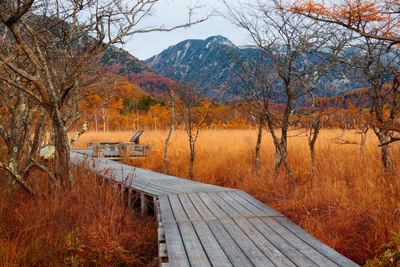
Along the boardwalk, you can also see small piles of stones said to have been stacked by families praying for the salvation of children who have died.
On the valley floor enclosed by the boardwalk, a hot spring source said to be the oldest in Nasu bubbles up from the ground.
Noticing the valley's shape and the views along the boardwalk helps you get a feel for the place.
How the Killing Stone Got Its Name and Its Link to Volcanic Gas
The name comes from a story in which a fox transformed into a stone that gave off poisonous fumes and harmed living creatures.
Volcanic gases, including hydrogen sulfide, still escape around the site, making it difficult for plants to grow.
Small animals are thought to have gathered in winter on ground warmed by volcanic steam and sometimes died from toxic gases, a possible explanation for the legend's origins.
Even as you enjoy the legend, remember that volcanic gases are a real presence here, and view the site only from designated areas.


The Nine-Tailed Fox Legend and Matsuo Bashō's Visit to the Killing Stone
The Killing Stone's background includes a supernatural fox story and a travel account left by an Edo-period haiku poet.
The Fox Disguised as Tamamo-no-mae and the Monk Gennō
According to legend, after committing evil deeds in India and China, the nine-tailed fox disguised itself as a woman named Tamamo-no-mae during the Heian period and became the emperor's favorite at court.
When the emperor fell ill, an onmyōji, a practitioner of traditional divination and ritual, exposed the fox; it fled to Nasu, where Kazusa-no-suke Hirotsune and Miura-no-suke Yoshizumi cornered and killed it, after which it became a great stone emitting poisonous fumes.
The story continues that the monk Gennō struck the stone, breaking it into 3 pieces that flew apart, 1 of which remained here.
Reading these accounts as local legends reveals the connection between the rocky scenery and Japan's storytelling traditions.
The nine-tailed fox story has also been performed in Noh, Kabuki, and ningyō jōruri puppet theater.
The Killing Stone in Bashō's The Narrow Road to the Deep North
Matsuo Bashō visited the Killing Stone in 1689 and described the surrounding area in his travel account The Narrow Road to the Deep North (Oku-no-hosomichi).
He wrote that the stone's poisonous fumes had not yet faded, and that dead bees and butterflies lay piled so thickly that the sand beneath was hidden.
He also composed a haiku, “The stone's scent—summer grasses red, the dew hot,” evoking the smell around the stone and the summer landscape.
The Killing Stone is one of the nationally designated Places of Scenic Beauty in the “Landscapes of Oku-no-hosomichi” collection, making it a place to reflect on the relationship between literature and landscape.
It received its scenic designation on March 18, 2014, after being designated a cultural property of Tochigi Prefecture in 1957.
Nasu Gojinka-sai: A Fire Festival to Appease the Nine-Tailed Fox
The Nasu Gojinka-sai fire festival normally takes place at the Killing Stone on the evening of the last Sunday in May.
Said to have begun with prayers to calm eruptions of Mount Chausu, the event continues in Nasu Yumoto today as a festival for good health and abundant harvests.
Participants dressed in white and wearing fox masks carry torches from Nasu Yuzen Shrine to the Killing Stone, where a large sacred fire is lit.
After the lighting, performers in golden wigs and fox masks present a Hakumen Konmō Kyūbiko Taiko drumming performance, named for the white-faced, golden-furred, nine-tailed fox.
The festival may be canceled in rain or severe weather, and the Killing Stone parking area may be unavailable during the event, so check information from the organizer, the Nasu Town Tourism Association, before visiting.
Words You May Encounter on Killing Stone Information Boards
If you are unfamiliar with Japanese folklore or beliefs, understanding the terms used on the signs can enrich your visit.
Here are words that help explain the story and the names of the rocky landscape.
| Term | Meaning and Context | What to Keep in Mind |
|---|---|---|
| Nine-tailed fox | A supernatural fox with golden fur and 9 tails | The central figure of the story |
| Tamamo-no-mae | The court woman whose form the fox assumed | A legendary figure |
| Sai-no-kawara | A riverbank where the souls of deceased children are believed to remain | A name rooted in religious belief |
| Jizō | A bodhisattva believed to protect travelers and children | A focus of memorial offerings and prayer |


Things to See at the Killing Stone: The Split Rock, Sentai Jizō, and Kyōden Jizō
During your walk, notice not only the Killing Stone but also the Jizō statues along the boardwalk and the wishes they represent.
View the Killing Stone That Split in 2022 from a Distance
The Killing Stone was found split in 2 in March 2022, so its appearance differs from photographs taken before then.
After the split, the Nasu Town Tourism Association held a memorial service and a ceremony praying for peace.
Use the information boards to locate the stone, then view its shape and the surrounding rocks from accessible viewing areas.
When reading older material, distinguish the legendary story of Gennō breaking the stone from explanations of the actual split in 2022.
Look at the Faces and Hand Gestures of the Sentai Jizō Statues
Jizō statues known as Sentai Jizō, meaning “1,000 Jizō,” line the boardwalk around the Killing Stone.
They began as a community effort to carve and dedicate Jizō statues, with the first statue installed in 1978.
The statues embody donors' wishes to avoid travel accidents and natural disasters, and their facial features and hand gestures vary.
Their faces point toward Renge-ji Temple, where Kyōden, introduced below, served as head priest.
Quietly observing each figure's expression and prayerful hand gestures helps you appreciate the hopes people have brought to this landscape.
Kyōden Jizō and the Legend of a Monk Who Mistreated His Mother
Kyōden Jizō, whose name is also written with an alternative set of kanji characters, is associated with a legend about a monk named Kyōden who met with disaster after treating his mother badly.
In the early 14th century, Kyōden, head priest of Renge-ji Temple in present-day Fukushima Prefecture, is said to have cursed his mother and kicked away the meal tray on the morning he left for Nasu Onsen.
As he approached Sai-no-kawara to see the Killing Stone, fire and boiling water erupted from the ground, and he is said to have died as divine punishment.
The story is linked to a wish that people not cause their parents grief and is told as part of the background to enshrining the Jizō statue.
The first Kyōden Jizō was erected in 1720, and a new statue was installed in 1982; a memorial ceremony for Kyōden is held each year in late May.
Do not touch offerings or stone statues, and if people are praying, keep your distance and view the site quietly.
Former Mineral-Deposit Collection Sites: Hot Springs and Everyday Life
Around the Killing Stone were places for collecting yu-no-hana, or hot spring mineral deposits, which were once gathered by covering steam-emitting cracks in the rocks with grass mats.
Yu-no-hana forms when substances in hot spring water or steam cool and crystallize, and it has long been used as a natural bath additive.
It was a valuable product during the Edo period, and some farmers paid their annual taxes with it instead of rice, showing how hot springs supported people's livelihoods.
Alongside the legends of the rocks, take a moment to consider the lives of people who made use of these hot springs.


Visiting the Killing Stone: Be Aware of Volcanic Gas and Hydrogen Sulfide
Hydrogen sulfide is released around the Killing Stone, so prioritize checking local warning signs and permitted access areas.
The walking paths are maintained, but take particular care if visiting with young children or pets.
Check Visitor Information Before Leaving and at the Entrance
Before visiting, check information from Nasu Town or the Nasu Town Tourism Association, and look for closure notices or warnings at the entrance.
Mount Nasu is an active volcano for which the Japan Meteorological Agency issues volcanic alert levels, so also check the agency's volcanic information before setting out.
Do not enter areas marked by no-entry signs or fences, and if trail directions are unclear, stop and check before continuing.
Do Not Judge Safety by the Strength of the Smell
Hydrogen sulfide is a colorless, toxic gas with a rotten-egg smell that can cause respiratory paralysis and other effects at high concentrations.
High concentrations can paralyze the sense of smell, so you cannot judge safety simply by whether you can smell the gas.
Concentrations can be locally higher in depressions or on days with little wind, so avoid lingering in low-lying areas.
Do not approach rock crevices or volcanic vents to check the smell; if you feel unwell, stop your visit and leave the area.
Choose Shoes and Luggage That Make Boardwalk Walking Easier
Although a boardwalk is provided, wear slip-resistant shoes that let you walk while watching your footing.
Do not push on when surfaces are wet from rain, snowy, or icy; be prepared to turn back if walking is difficult.
Pack so that you can use both hands easily, and avoid staring at your smartphone screen while walking.
Take Photos with Consideration for Walkways and Places of Prayer
Check local signs before taking photos, and stop somewhere that does not obstruct walkers or worshippers.
Even if you want a close-up of the Killing Stone or a Jizō statue, compose your shot from a permitted viewing area rather than stepping onto the rocks.
Here are ways to be considerate in different photography situations.
| Situation | What to Do | What to Avoid |
|---|---|---|
| Photography on the boardwalk | Leave enough room for people to pass | Blocking the walkway for a long time |
| Near stone statues | Photograph them as they are | Moving statues or offerings |
| When worshippers are present | Be mindful of people appearing in your photos | Taking close-ups of faces without permission |


Killing Stone Admission, Visit Duration, and Facilities
The Killing Stone is normally free to visit; check permitted visiting hours and access areas before you go.
Daylight is the safer choice, as footing and warning signs are harder to see at night.
Allow around 30 minutes to walk the boardwalk and see the Killing Stone, or about 1 hour if including the Sentai Jizō and other sights.
There is parking and a public restroom near the historic site.
Check mobile coverage and luggage storage options before setting out; leaving large bags at your accommodation or elsewhere makes walking easier.
For visitor inquiries, contact the Nasu Town Tourism Association at 0287-76-2619.

How to Get to the Killing Stone and Explore Nasu Yumoto Onsen
By public transportation, you can take a local bus from JR Nasushiobara Station or Kuroiso Station toward Nasu Yumoto Onsen.
Walk from Nasu Yumoto Onsen Bus Stop
Check Kantō Jidōsha's Nasu Line and plan to walk toward the Killing Stone from Nasu Yumoto Onsen bus stop.
Destinations vary by service, so confirm that your bus stops at the required stop before boarding.
Kantō Jidōsha buses use a winter timetable from December 1 to March 31, so check the schedule again if visiting in winter.
Checking your return bus time and deciding when to finish your walk helps you organize your time in the hot spring town.
When finding your destination on a map, saving both “Killing Stone” and “Nasu Yumoto Onsen” makes it easier to check your route in both directions.
Driving to the Killing Stone
By car, use Nasu Interchange on the Tōhoku Expressway or Nasu Kōgen Smart Interchange, which is only for vehicles equipped with ETC electronic toll collection, then follow Nasu Kaidō, Prefectural Route 17, toward Nasu Yumoto.
Nasu Kaidō is prone to traffic congestion, particularly during the autumn foliage season, so leave with time to spare.
There is parking near the Killing Stone, but nearby parking areas can become crowded during popular travel periods and consecutive holidays.
Nearby Nasu Yuzen Shrine and the Hot Spring Town
Nasu Yuzen Shrine is very close to the Killing Stone and makes a possible additional stop on a walk around the site.
The shrine is said to originate with Karino Saburō Yukihiro's discovery of a hot spring while following a white deer, and it is also known for its association with Nasu no Yoichi.
If you visit, follow the signs and guidance within the shrine grounds and experience the beliefs connected with the stone's legend and the hot springs in their respective settings.
Shika-no-yu, a hot spring bath named after a legend of an injured deer healing its wounds in the water, is about a 10-minute walk, or 0.4 km, from the Killing Stone.
If you plan to bathe at Nasu Yumoto Onsen, check each facility's operating status and bathing procedures, and leave time for your return transportation.
Nasu Kōgen Visitor Center is also useful for maps of the area and information about nature.
From April to November, Nasu Kōgen Visitor Center opens from 8:30 a.m. to 5:30 p.m. and normally closes on Wednesdays, or the following day if Wednesday is a public holiday; restrooms and rest areas are free to use.
Planning Your Killing Stone Visit
The Killing Stone is a Nasu Yumoto historic site where the nine-tailed fox legend, prayers at the Sentai Jizō statues, and Matsuo Bashō's travels meet within a rocky landscape.
Learning the legend's background and quietly viewing the stone that split in 2022 and the Jizō statues deepens your understanding of the place.
Prioritize local warning signs and your physical condition, be mindful of volcanic gases, and plan a manageable visit combined with a walk through Nasu Yumoto Onsen.



Reviews (0)