


Experience All of Oyama Shrine, Starting at the Shinmon Gate
Located in central Kanazawa, Oyama Shrine (Oyama Jinja) is both a place of worship associated with the Maeda family and a site where you can see architecture and a garden reflecting the fresh sensibilities of the early Meiji period.
Rather than stopping only at the Shinmon gate at the front, shift your attention to the main sanctuary, the red-brick tamagaki fence, and the shrine garden to gain a fuller sense of how tradition and modernity overlap throughout the grounds.
Begin by Taking In the Shinmon Gate as a Whole
Step back slightly from the road and look at how the outline of the 3 tiers changes as it rises. This makes the gate's overall composition easier to understand.
Follow the gate upward from the 1st tier clad in Tomuro stone, to the upper section with its striking railings and curves, and finally to the top tier fitted with colored glass. You can then see how different styles were brought together in a single gate.
Separate the Order of Worship from the Order of Observation
After passing through the Shinmon gate, it feels natural to proceed first to the worship hall, pay your respects, and then take another unhurried look at the architecture and garden around the grounds.
By showing respect for the sacred space before concentrating on photography or architectural details, you can enjoy both sightseeing and worship calmly.
Organizing the main highlights in advance also helps you know where to look, even during a short visit.
| Place | Feature to Notice | Viewing Tip |
|---|---|---|
| Shinmon gate | 3-tier structure and colored glass | Compare the distant frontal view with a close view from below |
| Around the main sanctuary | Main sanctuary and red-brick tamagaki fence | Notice the contrast between traditional architecture and modern materials |
| Shrine garden | Pond, islands, bridges, and stone arrangements | Change your position as you walk and observe how the views overlap |


Learn About the Maeda Family and Kanazawa Before You Worship
Behind Oyama Shrine are both the desire to honor Maeda Toshiie, founder of the Kaga Domain, and the efforts of Kanazawa's people at the dawn of the Meiji period to preserve the city's memories for the future.
Rather than memorizing dates, focus on who is enshrined and why the shrine buildings and Shinmon gate were constructed here. This changes the way you see the grounds.
The Origins of Worship Honoring Lord Toshiie
After Lord Toshiie died, Maeda Toshinaga, the 2nd lord of the domain, founded Utatsu Hachimangu at the foot of Mount Utatsu to enshrine his father, and successive generations of the Maeda family held it in deep reverence.
Knowing this earlier history helps you understand that Oyama Shrine is not simply a modern landmark, but a place carrying forward a long tradition of respect for the Maeda family.
A New Shrine Born on the Former Kanaya Palace Site
After the abolition of the domains and establishment of prefectures, former retainers and others began a movement to transfer Lord Toshiie to the now-vacant site of Kanaya Palace, and Oyama Shrine was founded there in 1873.
The shrine's distinctive character comes from the rebuilding of a regional symbol in a new form during a period when the institutions of the castle town were undergoing major change.
Remember Lord Toshiie and Lady Matsu Together
In the present main sanctuary, Lord Toshiie and his lawful wife, Lady Matsu, are enshrined side by side, while the grounds also preserve connections with successive generations of the Maeda family.
Looking beyond the warrior's achievements to the story of the couple who supported their household and region can make the meaning of worship feel more personal.


Examine Every Detail of the Shinmon Gate's Japanese, Chinese, and Western Design
Completed in 1875, the Shinmon gate is a pseudo-Western-style building clad in Tomuro stone that combines Japanese, Chinese, and Western design elements.
Because it is a National Important Cultural Property, observe the whole structure and its details in turn from a distance, without touching it or obstructing passage.
Find a Modern Expression in the Tomuro Stone and Arches
On the 1st tier, Tomuro stone cladding, a material also used in Kaga Domain architecture, and 3 broad arches create a powerful entrance.
After taking in the substantial weight of the stone, raise your eyes to the lighter railings and windows above. The design's transition from weight to brightness then stands out.
View the Colored Glass in Different Light
Colored glass fills the 3rd tier, and the five-colored light it once cast also served as a lighthouse.
The colors look different depending on the weather and viewing direction. Do not treat clear skies as the only ideal condition; appreciate the soft colors on cloudy days and the evening silhouette as expressions unique to that day.
When looking at high features such as the lightning rod and rooftop carvings, stop in a safe place instead of gazing upward while walking.
This lightning rod is said to be the oldest surviving one in Japan and is one of the features that conveys the Shinmon gate's history.


Walk from the Main Sanctuary to the Shrine Garden and See Tradition Meet Modernity
Beyond the Shinmon gate, the scenery continues with the traditional main sanctuary alongside materials and an urban sensibility introduced from the Meiji period onward.
Instead of collecting highlights as isolated points, notice how the atmosphere changes as you proceed from the entrance toward the back. The entire shrine grounds then become a single story.
Compare the Main Sanctuary and Red-Brick Tamagaki Fence
A red-brick tamagaki fence featuring openwork versions of the ken-umebachi crest surrounds the main sanctuary.
Frame the traditional rooflines and the modern color of the brick in the same view, and you will find another fusion of Japanese and Western styles beyond the Shinmon gate.
Quietly Appreciate the Decorations in the Worship Hall
In the worship hall, you can also notice decorations that preserve memories of the former Kanaya Palace, including the plaque bearing the shrine's name, the ceiling, and the transoms.
When a festival or prayer service is underway, give it priority and follow the guidance on restricted areas and photography while viewing from a distance.
Follow the Composition of Water and Islands in the Shrine Garden
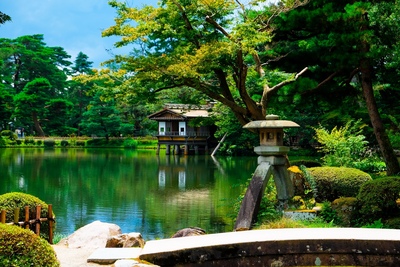
The shrine garden, a Place of Scenic Beauty designated by Ishikawa Prefecture, is a strolling pond garden with islands modeled after gagaku instruments and other features.
Take your time along the pond's edge and look for places where islands overlap beyond a bridge or where the water opens between the trees. You will discover the garden's appeal as its scenery rearranges itself with every step.
A recommended route can be organized as follows.
| Stage | Action | What to Keep in Mind |
|---|---|---|
| Entrance | View the Shinmon gate from a distance | The proportions of its 3 tiers and its relationship to the cityscape |
| Center | Worship at the worship hall | Proceed quietly without blocking the flow of visitors |
| Surroundings | Walk around the main sanctuary and shrine garden | Observe changes in materials, light, and the water's surface |
| Exit | View the Shinmon gate from another angle | How the impression differs from when you entered |


Enjoy Photography and Note-Taking While Showing Respect
Oyama Shrine offers many subjects for architectural photography, but it remains an active place of prayer.
Avoid making photography your sole purpose. Respecting the flow of worshippers and the quiet of the grounds will also lead to calmer observation.
Find a Composition Without Monopolizing the Front View
People tend to gather directly in front of the Shinmon gate and worship hall, so yield the spot promptly after taking a photo and avoid blocking the center of the approach for long.
You can also try compositions that do not create congestion, such as moving slightly to either side to frame overlapping stone and wood, or viewing a building across the pond.
Record Differences in Color and Material in Words Too
Along with photographs, briefly noting the subdued color of the Tomuro stone, the warmth of the brick, and the greenery reflected on the water will make it easier to recall the experience later.
When recording the shrine's history or traditions, it is also important not to confuse facts confirmed on-site with your own impressions.

Check Transportation and Same-Day Information Before Your Visit
The shrine is easy to include in a city itinerary, but festivals, events, seasons, or construction may change access routes and reception conditions.
Check the day's information before departure and leave enough time so you do not have to rush your worship.
Plan Your Time Around Public Transportation
From Kanazawa Station, you can take a bus or taxi and walk to the shrine from the nearest indicated point.
Road conditions and service intervals vary by day, so do not rely only on a fixed travel time. Check the transportation operator's service information, including options for your return trip.
Match Your Clothing and Belongings to the Weather
The shrine grounds and garden include stone paving, steps, and waterside areas, and the footing may become slippery after rain or snow.
Choose comfortable walking shoes, and for peace of mind prepare rain gear that is unlikely to bump into people around you.
If your purpose is to visit the amulet office, request a prayer, or attend a special event, prioritize the day's information because the hours may differ from those for general worship.
Summary: Take Time to Read the Layers of History at Oyama Shrine
Beginning with the Shinmon gate and its gleaming colored glass, Oyama Shrine presents a sequence of highlights: devotion to the Maeda family, the contrast between traditional architecture and red brick, and a shrine garden shaped by water and islands. Pay your respects first, then walk from the whole to the details and from the architecture to the garden. In this way, you can naturally experience both the history Kanazawa has inherited and the city's openness to new ideas.



Reviews (0)